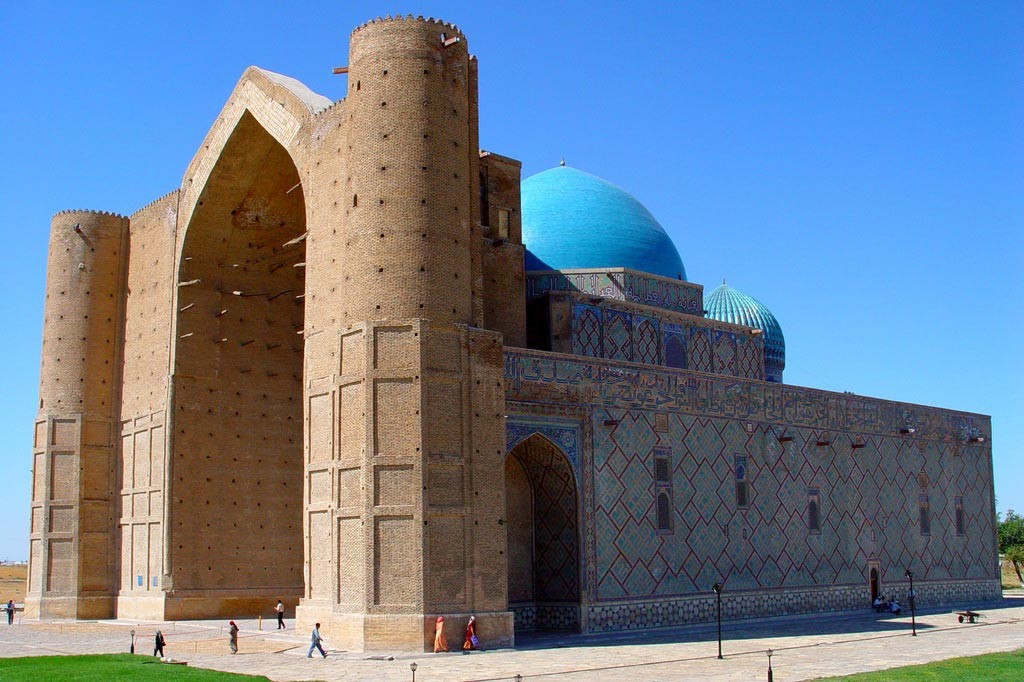
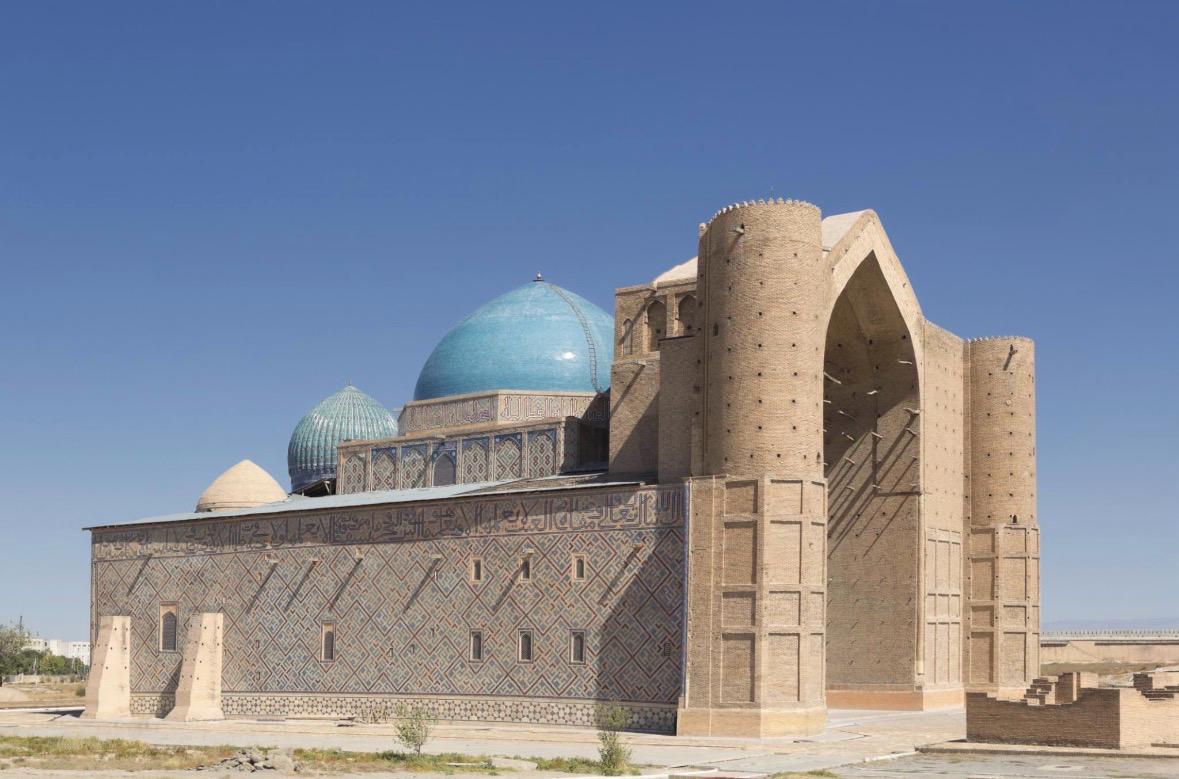
The Mausoleum of Khoja Ahmed Yasawi is among the most significant architectural and historical landmarks in Central Asia. Situated in the heart of Turkistan, it is regarded as one of the most sacred sites in the Islamic world. The monument was erected to commemorate Khoja Ahmed Yasawi, a renowned philosopher, poet, and Sufi spiritual leader who earned the honorific title “Sultan al-Arifin,” meaning “Leader of Those Who Know God,” during his lifetime.
This is a cultural heritage site of international significance. Many khans, biys, sultans, batyrs, and military leaders who played an important role in the history of the Kazakh people were buried near the mausoleum according to their wishes.
In 1928, the scholar M. E. Masson suggested that an earlier mausoleum of Khoja Ahmed Yasawi had existed before the present structure. According to his hypothesis, a small shrine was initially erected over the saint’s grave. During roof repairs in 1923, five fragments of decorated ceramic tiles were discovered, which may have been used to adorn the façade of the original mausoleum. Restoration work carried out between 1939 and 1941 revealed bricks and ceramic elements belonging to the earlier structure. In 1957, while repairing the western support of the northern portal, the walls of the first mausoleum were uncovered. These remains were thoroughly studied during restoration work in 1975. In 1994, more than sixty large and small fragments of terracotta ornamentation were found on the roof of the mausoleum.
After analyzing this evidence, archaeologist Erbolat Smagulov concluded that the original mausoleum of Khoja Ahmed Yasawi was one of the most beautiful and richly decorated architectural monuments of its time. Its exterior was adorned with floral and geometric patterns, a characteristic feature of many monuments built during the second half of the 12th century. Architecturally, the first mausoleum resembled famous Karakhanid-era monuments such as the Uzgen Mausoleums, the Mausoleum of Ibrahim ibn Husayn, and the mausoleums of the Shah-i-Zinda complex in Samarkand.
Construction of the New Mausoleum in the Late 14th and Early 15th Centuries
In the 14th century, the ancient city of Yasi was a relatively small settlement. However, the widespread adoption of Islam across the Dasht-i Kipchak steppe and the conversion of Genghis Khan’s descendants to Islam significantly increased the prestige of Yasi, where Khoja Ahmed Yasawi was buried. The discovery of glazed and unglazed terracotta artifacts dating from the 12th-14th centuries near the original mausoleum indicates that new structures were being built in the area. At the end of the 14th century, Amir Timur (Tamerlane) brought the regions along the Syr Darya River under his control. The city of Yasi was first mentioned in historical records during the wars between Amir Timur and Tokhtamysh Khan. Both sides fought for a long time over the cities located along the middle reaches of the Syr Darya. In 1388, after failing to capture the city of Sauran, Tokhtamysh Khan attacked and plundered Yasi. According to local legends, during one of these campaigns the mausoleum of Khoja Ahmed Yasawi and the religious figures serving there suffered damage. Later, Amir Timur defeated Tokhtamysh and recovered the looted property. Following this victory, he ordered the construction of a magnificent mausoleum over Khoja Ahmed Yasawi’s grave. The historian Sharaf ad-Din Ali Yazdi, in his work Zafarnama (“Book of Victory”), records that in 1397 Amir Timur visited Yasi, made a pilgrimage to the saint’s tomb, and ordered the construction of a new mausoleum. Timur personally determined the principal dimensions of the building. According to the plan, the structure was intended to be a grand and monumental architectural masterpiece. According to scholar M. E. Masson, the construction served not only religious purposes but also political ones. By honoring a saint highly respected among the nomadic peoples, Amir Timur sought to strengthen his authority and demonstrate the power of his empire. Nevertheless, some researchers believe that construction may have begun earlier, in the early 1390s. Because of Amir Timur’s death in 1405, several parts of the building remained unfinished.
Architecture and Structure of the Mausoleum
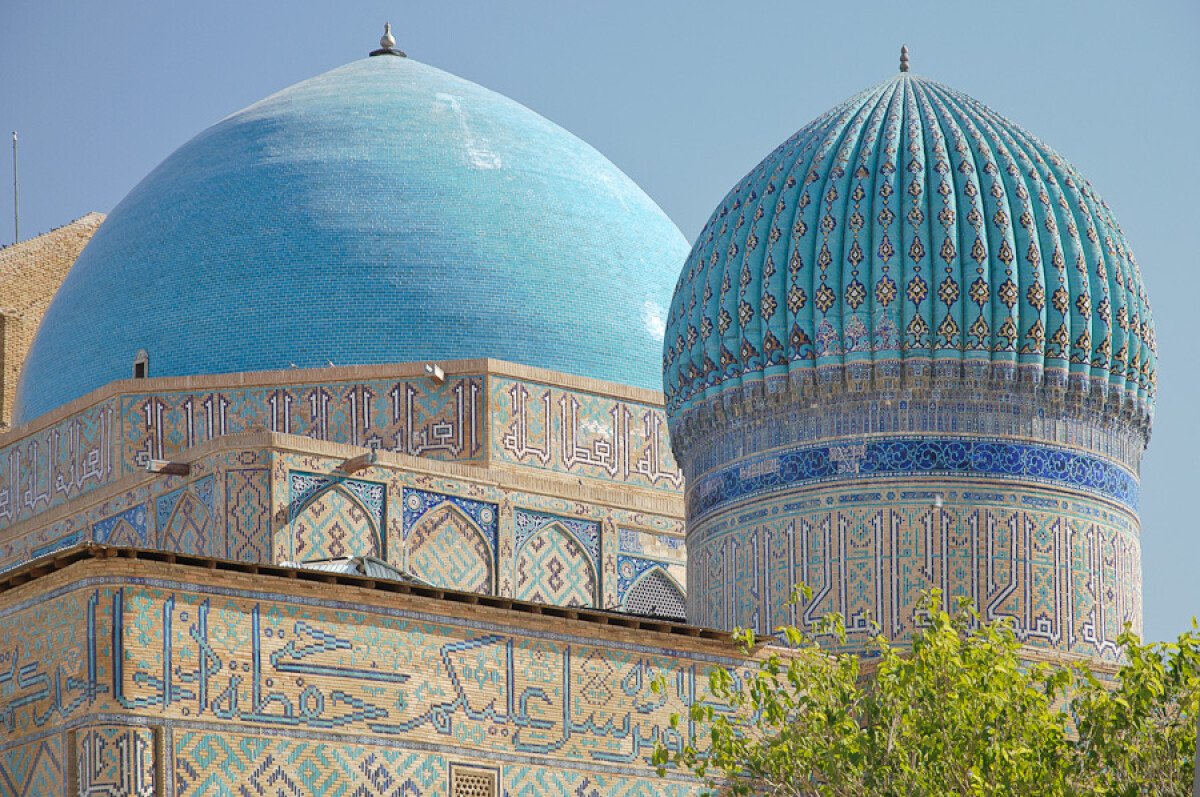
The Mausoleum of Khoja Ahmed Yasawi is a unique architectural complex that combines the functions of a mausoleum, mosque, khanqah, and madrasa. The building consists of 34 rooms. Its main components include a monumental portal, the Kazandyk Hall, and the burial chamber. The overall dimensions of the complex are 65.5 by 46.5 meters. The construction of such a large unified complex, instead of several separate buildings, was considered a major architectural achievement of its era. Upon entering through the main entrance, visitors arrive at the Kazandyk Hall, the central space of the complex. Each wall of the hall measures 18.5 meters in length. The chamber was designed to be exceptionally spacious and lofty. At the very center of the hall stands the famous Taikazan, a unique masterpiece of medieval bronze casting. It was crafted by the master artisan Abd al-Aziz ibn Sharaf ad-Din Tabrizi. The Kazandyk Hall is crowned by one of the largest domes in Central Asia and Kazakhstan. Its exterior is covered with glossy green ceramic tiles. The dome rises to a height of 39 meters. The interior is decorated with carved stalactite-like elements (muqarnas) and a variety of ornamental patterns. These outstanding features make the Mausoleum of Khoja Ahmed Yasawi one of the most valuable historical and architectural monuments not only of the Kazakh people but of the entire Turkic world.
Source: azretsultan.kz