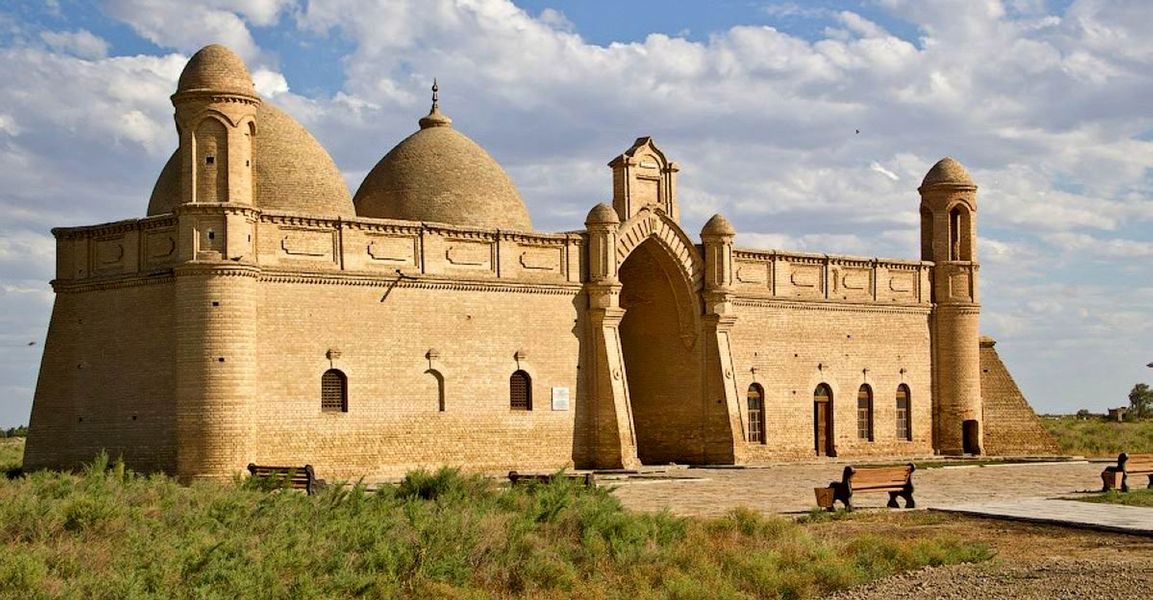
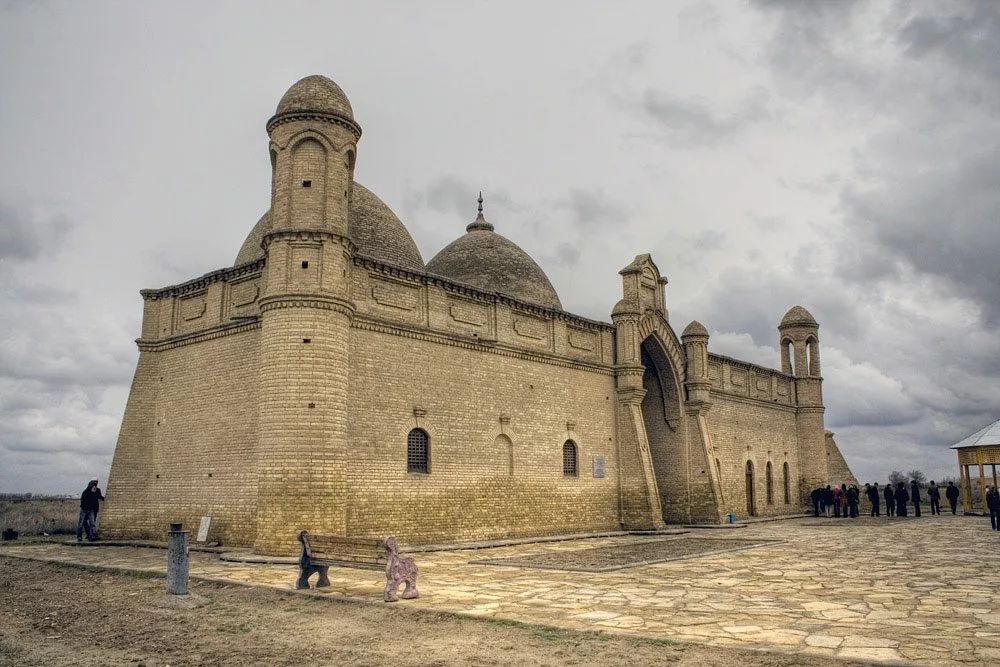
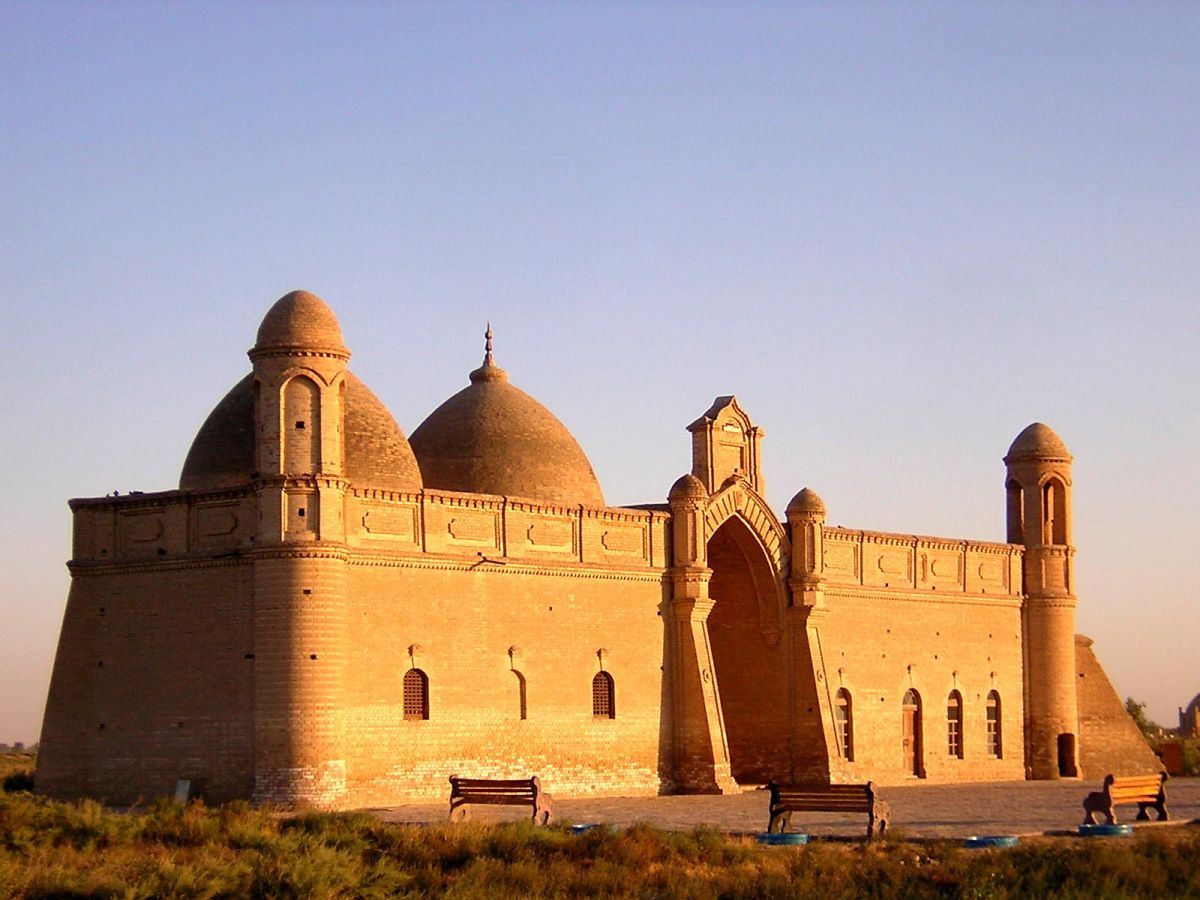
The Arystan Bab Mausoleum is a remarkable architectural monument located in the ancient region of Otrar. The mausoleum was built over the grave of Arystan Bab, the spiritual mentor of Khoja Ahmed Yasawi, who played a significant role in spreading Islam among the people of the Turkestan region. The complex consists of a corridor, a mosque, living quarters (hujras), and a minaret used for the call to prayer. The oldest part of the structure is believed to be the burial chamber, whose floor is noticeably higher than those of the other rooms. Historians believe that the first structure above the grave was erected around the 12th century, while major restoration work was carried out in the 14th century. At the beginning of the 20th century, the mausoleum was rebuilt with funds collected by local residents using fired brick. Its dimensions reached 35 meters in length, 12 meters in width, and 12 meters in height. Originally, the entrance faced Mecca, but after reconstruction it was reoriented toward Turkestan and the Hazrat Sultan Mausoleum. The northern section served as a pilgrimage area, while the southern part functioned as a mosque. A marble plaque above the entrance bears the Hijri date 1327, indicating the time of the last major construction work.
Brief Information
The mausoleum stands above the burial site of Arystan Bab, a religious figure who lived during the 12th century. The earliest known structure dates back to the 14th-15th centuries. Some elements of the original ayvan have survived from that period. After a powerful earthquake in the 18th century, a new double-domed structure was built on the site of the old mausoleum. Over time, the building deteriorated, and in 1909 it was reconstructed once again. In 1971, the mosque section was demolished and rebuilt due to damage caused by rising groundwater levels. The complex was constructed from fired brick using alabaster mortar. Today, the mausoleum is regarded as one of the most important Muslim pilgrimage sites in Central Asia. According to legend, Arystan Bab was the guardian of a sacred trust entrusted by the Prophet Muhammad. One day, while the Prophet was eating dates with his companions, a single date repeatedly fell from the dish. It was then revealed that this date was destined for a boy named Ahmed, who would be born four hundred years later. When the Prophet asked who would deliver the date, only Arystan Bab volunteered, requesting from God a lifespan long enough to fulfill the mission. He later delivered the date to Khoja Ahmed Yasawi and became his teacher. Today, the mausoleum occupies an area of approximately 30 by 13 meters. Historical records indicate that between the 12th and 18th centuries the structure was rebuilt and renovated several times.
Legends About Arystan Bab
Many legends and folk stories are associated with Arystan Bab. One of them appears in the spiritual poems (hikmets) of Khoja Ahmed Yasawi, where the saint’s final days are described. Before his death, Arystan Bab is said to have given instructions to his disciple and entrusted him with the responsibility of conducting his funeral rites. Another well-known legend states that after Arystan Bab’s death, his body was placed on a white camel and the animal was allowed to wander freely. Eventually, the camel knelt at the site where the mausoleum now stands. The saint was buried at that very location. Arystan Bab is also mentioned in the Kazakh epic Alpamys Batyr, where he is honored as the greatest among the revered saints of the region:
"In Otrar there are thirty saints,
But if one asks who is the greatest among them,
The answer is Arystan Bab."
An old manuscript preserved in the collection of the Hazrat Sultan Museum-Reserve mentions another interesting story. It says that after the saint’s death, two birds-a falcon and a crow-appeared above his grave. This tale is linked to ancient Turkic beliefs, in which these birds were regarded as sacred. In Kazakh culture, the crow was considered a respected and symbolic bird and affectionate expressions such as “qarğam” and “qarğaşım” were often used when addressing children and grandchildren.
Architectural Structure
Throughout the centuries, the Arystan Bab Mausoleum has undergone numerous reconstructions and restorations. Some researchers suggest that a memorial structure may have been erected shortly after the saint’s death. However, no clear architectural features from the 12th century have survived in the present building. One possible explanation is that in the early period of Islam, constructing large roofed structures over graves was generally discouraged. According to descriptions by the researcher A. Cherkasov, the mausoleum originally consisted of a chamber containing the saint’s grave, a room for his disciples, and a covered veranda. Specialists note that these elements correspond to the architectural traditions of the 14th century. A famous legend involving Amir Timur (Tamerlane) is also connected with the mausoleum. According to the story, while the mausoleum of Khoja Ahmed Yasawi was being built, its walls repeatedly collapsed. Troubled by these events, Timur received a vision in which an elderly man instructed him to first build a mausoleum over the grave of Arystan Bab. Once this command was fulfilled, construction in Turkestan proceeded successfully. The burial chamber is covered by a large and elevated dome. Its entrance faces the direction of Mecca. Inside the chamber are three graves. According to local tradition, the two smaller tombs located beside the saint’s grave belong to Lashyn Bab and Karga Bab. The remaining rooms are connected by corridors and lead into the mosque section. Inside the mosque is a mihrab, indicating the direction of Mecca.
Research and Study
The first scientific references to the Arystan Bab Mausoleum appeared in 1898. Significant contributions to its study were made by I.T. Poslavsky, A. Cherkasov, and I.A. Kastanye. Later, the architectural characteristics of the monument were examined in detail by V.V. Konstantinova, M. Sembin, and other scholars. According to some sources, the architect responsible for the reconstruction at the beginning of the 20th century was Iskander Hajji of Tashkent. Thanks to the work of researchers and historians, the history and architectural significance of the mausoleum have been carefully documented and preserved.
The Arystan Bab Mausoleum in the 21st Century
In the 21st century, the world-renowned Arystan Bab Mausoleum began a new phase of development as a modern architectural and spiritual complex. The project was initiated by the statesman, engineer, scholar, and philanthropist Askar Kulybayev, whose goal was to preserve the nation’s spiritual heritage and strengthen the importance of this sacred site. His sons also made a considerable contribution to supporting and developing the complex. In addition, restoration and preservation efforts have been carried out within the framework of Kazakhstan’s “Cultural Heritage” State Program, which is aimed at protecting the country’s historical, cultural, and spiritual monuments.
Source: qazaqstan3d.kz