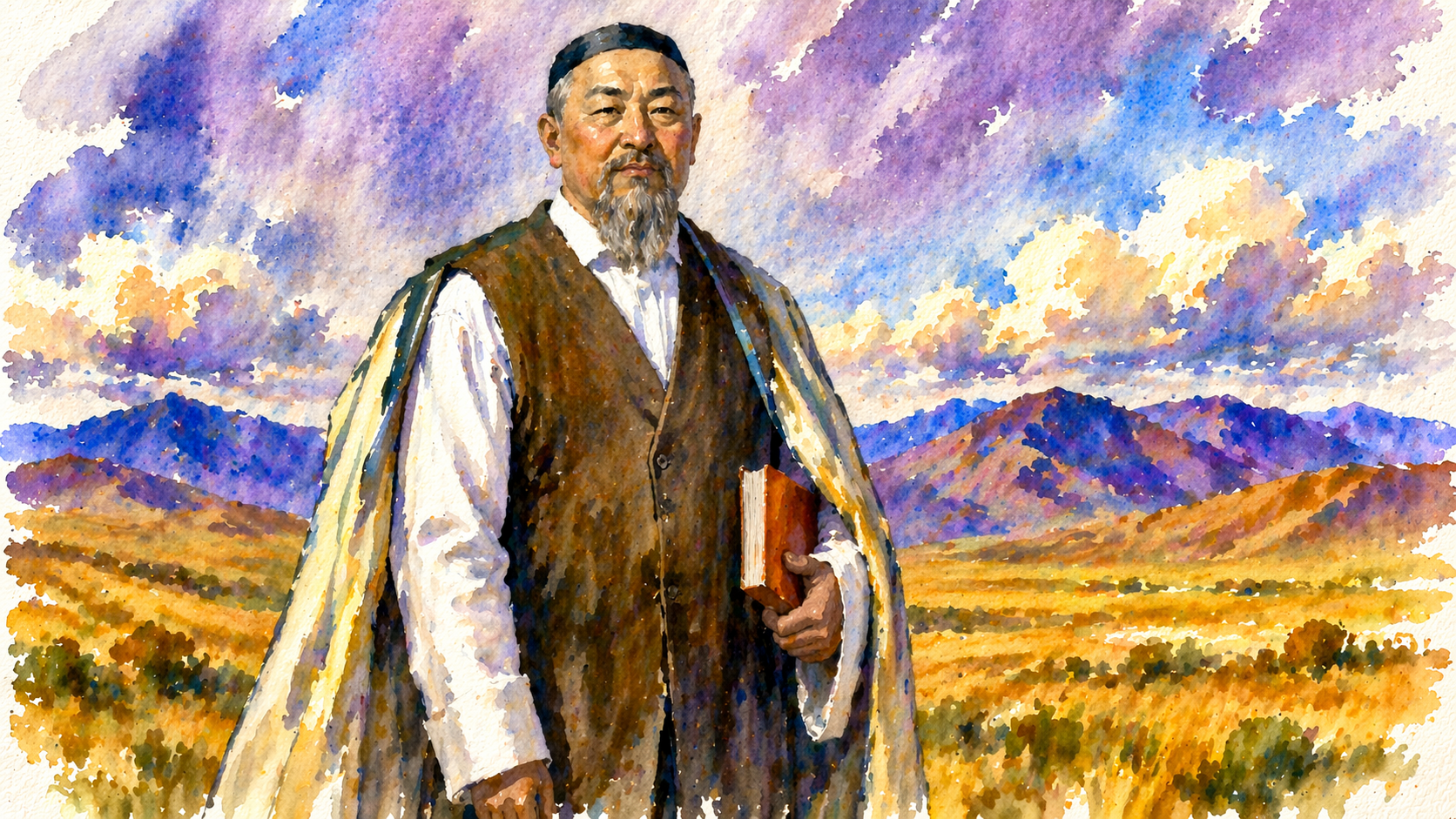
The great poet, composer, philosopher, and founder of Kazakh written literature and the literary language, Abai (Ibrahim) Kunanbaiuly (1845–1904), was born at the foot of the Shyngystau Mountains in the East Kazakhstan region. His lineage traces back to Olzhai Batyr of the Tobykty clan, part of the Middle Zhuz (Orta Zhuz). Three branches descended from Olzhai: Aidos, Kaidos, and Zhigitek. Aidos’s wife, the wise Aipara, once prophesied that among them, Irgizbai would rise to lead the people. Indeed, Irgizbai’s son, Oskenbai, became renowned in his era for his exceptional sense of justice, inspiring the folk proverb: “If your cause is just, go to Oskenbai; if it is crooked, go to Yeraly.” Abai’s father, Kunanbai Kazhy, was born to Oskenbai and his wife, Zerde. Kunanbai had four wives: Kunke, the eldest, bore Kudaiberdi; Ulzhan, his second wife, gave birth to Tanirberdi (Takezhan), Ibrahim (Abai), Yskak, and Ospan; and Aigyz, his third wife, bore sons Khaliulla and Ismagul. This heritage led Abai to describe himself as being one of six from his father, and one of four from his mother.
The formative years of young Ibrahim were profoundly influenced by the legends and tales of his grandmother, Zere, as well as the eloquent and deep upbringing provided by his mother, Ulzhan. He received his first lessons from Mullah Gabitkhan before spending three years at the Ahmad Riza Madrasah in Semipalatinsk. There, alongside religious teachings, he immersed himself in the heritage of the great Eastern poets: Nizami, Navoi, Saadi, Hafez, and Fizuli. Simultaneously, he began attending a parish school to master Russian literacy. However, noticing his son’s extraordinary abilities, Kunanbai withdrew him from formal studies at the age of thirteen to involve him in the governance of the people. Thus, Abai bid an early farewell to childhood; he absorbed the oratorical mastery of the biys (judges) and witnessed firsthand the social conditions of his people. During the intensification of the Russian Empire’s colonial policy, he remained a steadfast proponent of justice. Despite numerous investigations prompted by anonymous denunciations filed against him, he consistently emerged exonerated.
As he grew older, Abai taught himself the Russian language and literature, immersing himself in the works of Pushkin, Gogol, Lermontov, Shchedrin, and Nekrasov, as well as the treatises of the English scientist Darwin and the plays of Shakespeare. He maintained close ties with the exiled democrats Michaelis, Dolgopolov, and Leontyev in Semipalatinsk, introducing them to the traditions and customs of his people. Despite his affluent background, Abai chose to center his poetry on the inequality between the poor and the wealthy, as well as the hardships faced by common laborers. Although his poetic journey began in the 1860s, it was not until 1886 that he began signing works with his own name, starting with the poem Zhaz (Summer). Along with such verses as Zhaz (Summer), Kuz (Autumn), Kys (Winter), Segiz Ayaq (Eight-Line Stanzas), and Gylym Tappai Maqtanba (Boast Not Until You Have Found Knowledge), he composed the epic poems Eskendir (Iskander), Masgut (Masgut), Azim Angimesi (The Tale of Azim), and the profound philosophical work Qara Sozder (Words of Edification).
The great poet was not only a master of the word but also a composer, creating songs such as Ayttym Salem, Qalamqas (Greetings to You, Qalamqas), Zhelsiz Tunde Zharyq Ai (In the Moonlit, Windless Night), and many others that have held a special place in the hearts of the people. He left behind ten children: from his first wife, Dilda, were born Akylbai, Akimbai, Abdirakhman, Raikhan, Kulbadan, and Magauiya; and from his second wife, Aigerim, were born Turagul, Mekayyl, Izkail, and Kenzhe. Abdirakhman, Magauiya, Turagul, and Mekayyl became talented protégés who carried on their father’s creative legacy. The poet passed away in 1904 and was laid to rest in Zhidebai. Today, Abai’s heritage has been translated into many of the world’s languages, including Chinese, becoming a shared treasure of humanity. The Memorial Museum in Zhidebai and numerous monuments across the country stand as eternal testaments to his greatness.
The poet’s lineage originates in the Middle Zhuz (Orta Zhuz) from the renowned Tobykty clan of the Argyn tribe, specifically from Olzhai Batyr. Olzhai had three sons: Aidos, Kaidos, and Zhigitek, each of whom later became the founder of a significant separate branch. Aidos’s wife, the wise Aipara, prophesied that among them, Irgizbai would rise to lead the people. This prophecy came to pass, as Irgizbai became a prominent leader in his community. Irgizbai’s sons were Urker, Myrzatai, Zhortar, and Oskenbai. Oskenbai was known for his prudence in affairs and fairness in judgment, leading to the folk saying: “If your cause is just, go to Oskenbai; if it is crooked, go to Yeraly.” Kunanbai, who became a major historical figure in the destiny of the Kazakh people, was born to Oskenbai and his wife, Zerde.
Kunanbai Kazhy was married four times. From his eldest wife, Kunke, was born Kudaiberdi. His second wife was Ulzhan, who had originally been betrothed to his brother Kuttumukhambet; however, following his passing, she was widowed and entered Kunanbai’s family. Their sons were Tanirberdi (Takezhan), Ibrahim (Abai), Yskak, and Ospan. From his third wife, Aigyz, were born Khaliulla and Ismagul, while his fourth wife, Nurganym, whom he married in his later years, left no descendants. Abai’s lines, “From my father, we were six, and from my mother, four,” recount these very ancestral roots.
The development of the future poet’s personality was profoundly influenced by the upbringing of two noble women. His imagination was nourished by the endless legends and tales of his grandmother, Zere, who was called the “mother of the people” for her calm disposition and soulful generosity. Simultaneously, he was shaped by the influence of his mother, Ulzhan, who was distinguished by her gentle character, mastery of wit, and deep knowledge of folk customs.
Abai’s path to knowledge began with the village mullah, Gabitkhan; later, at the age of ten, he was sent to study at the Ahmad Riza Madrasah in Semipalatinsk. For three years within these walls, he studied religious subjects primarily in Arabic and Persian. Being significantly more capable than his peers, the boy devoted himself to his studies with great zeal and became the top student. He did not limit himself to religious texts and independently studied the works of the great classics of the East, such as Nizami, Navoi, Saadi, Hafez, and Fizuli, and acquainted himself with dastans (epics) and legends in the Arabic, Iranian, and Chagatai languages.
In his third year at the madrasah, Abai concurrently enrolled in a parish school in Semipalatinsk, where he began to master Russian literacy. However, this education was short-lived, concluding after only three months. Noticing that his son’s abilities and acumen far exceeded those of his surroundings, Kunanbai recalled him to the village (auyl) and began to involve him in administrative and judicial activities. Thus, at just thirteen years of age, the young Abai began to participate actively in the affairs of the people, entering the great school of life.
The Life Path of Abai
Although Abai did not seem overly bold or restless to his peers during his childhood, his discernment and innate thirst for knowledge set him apart. He drew attention with his extraordinary quickness of mind, grasping the tales of famous orators, poets, and storytellers on the fly. Young Ibrahim drew spiritual strength from listening to the songs and epics of such masters of the word as Shortanbai, Dulat, Bukhar Zhyrau, Marabai, and Shozhe. These qualities did not manifest in him by chance: his mother, Ulzhan, also came from a background of people who valued the weight of words and possessed the art of eloquence. Indeed, a witty remark by his maternal uncle, Tontai, made just before his death, even became a popular folk proverb. At the same time, the profound and substantive manner of speech of his father, Kunanbai Kazhy, impressed not only his contemporaries but also foreign travelers.
Abai’s journey toward enlightenment began at the age of eight in a madrasah built by his father in the Eskitam valley. It was here, under the tutelage of the village mullah, Gabitkhan, that he first discovered literacy. Recognizing his son’s remarkable acumen, Kunanbai sent the ten-year-old to the Ahmad Riza Madrasah in Semipalatinsk. After studying there for three years, Abai concurrently enrolled in a city parish school during his final year, where he mastered Russian literacy over the course of three months. As Mukhtar Auezov noted, he significantly surpassed his peers in diligence; if the mullah translated an Arabic text into Turkic just once, Abai, thanks to his phenomenal memory, could recite it by heart without even glancing at the book. Quickly mastering his lessons, he devoted all his free time to self-education and reading his favorite books. The verses he memorized in his childhood remained in his memory until old age.
The poet’s horizons of knowledge were incredibly vast: on one hand, he absorbed the creations of Eastern classics such as Nizami, Saadi, Hafez, Navoi, Fizuli, and Jami; on the other, he became deeply acquainted with the titans of Russian literature, including Pushkin, Lermontov, Tolstoy, Dostoevsky, and Turgenev, as well as Western stars like Goethe and Byron. In his mature years, he rose to such heights that he could engage as an equal in philosophical discussions with great thinkers and scholars. Masterfully translating their large-scale works into the Kazakh language, he created gems that, in their artistic power, sometimes surpassed the originals.
However, Kunanbai decided to direct his son’s exceptional abilities toward the governance of the people and brought him home from his studies at the age of thirteen. Engaging early in administrative and power-related activities, Abai clearly perceived the social contradictions within the Kazakh steppe, the cunning colonial policy of the Tsarist government, and the tyranny of corrupt officials. To oppose this system, which had become a calamity for the people, and to combat ignorant volost rulers, he was elected as a volost (district head) in the Konyrkekshinsky region from 1875 to 1878. During these years, he held the reins of power, exerting every effort to maintain the scales of justice.
Later, in the 1880s, he established close ties with members of the intelligentsia such as I. Dolgopolov and A.A. Leontyev, and in 1886, at the suggestion of E.P. Michaelis, he was elected a full member of the Semipalatinsk Regional Statistical Committee. Abai’s authority renowned for his fairness in public affairs, his profound knowledge, and his active leadership grew among the population with each passing day. Despite the spiritual suffering he felt for his people living under colonial dependency, he championed enlightenment and justice, becoming the spiritual guiding light of the nation.
Abai as a Politician and Public Figure
In May 1885, an extraordinary congress of immense historical significance took place in the Karamola area on the banks of the Shar River. Chaired by the Military Governor of Semipalatinsk, Tseklinsky, this gathering was attended by more than one hundred biys and volost rulers from five districts. At this representative assembly, Abai was elected as the tobe biy (chief judge), and he was entrusted with the development of the "Regulations on Counteracting Crimes" for Kazakh society. Under the poet's leadership, the commission prepared a unique document consisting of 93 articles in just three days and three nights. These regulations differed both from traditional customary law and the colonial laws of the Tsarist government; of particular value were the articles concerning theft, criminal offenses, and the status of women.
However, such authority only increased the number of Abai’s enemies. In 1890, in the Shi area, a group of influential individuals led by Baigulak and Kuntu initiated clandestine actions against him, and from 1891, a confrontation with Orazbai began, which lasted for seven years. This enmity led to a scandal during the Mukur elections of 1898 and an attempt on the poet’s life. In his letter to the Senate, Abai used factual evidence to substantiate the repulsive truth of those events and proved his case. In the governance of his people, he never wavered from the principle of justice: “An honest judge has no kin.” Towards the end of his life, he devoted his attention entirely to his creative work.
Regarding the poet’s personal life, it should be noted that he was married three times. From his eldest wife, Dilda, were born Akylbai, Abdirakhman, Kulbadan, Akimbai, Magauiya, and Raikhan. From his second wife, Aigerim, were born sons Turagul, Mekayyl, Izkail, and Kenzhe. In total, Abai raised seven sons and three daughters. He had no children with Erkezhan, whom he married in accordance with the custom of levirate marriage (amengershylyq). Abai’s poetic path began to take shape as early as the age of ten; following his initial youthful works, such as Yuzi-raushan (The Bright-Faced One) and Fizuli, Shemsi, he embarked on a systematic creative journey in the mid-1880s. Between 1870 and 1880, he composed poems such as Sap, Sap, Konilim (Be Still, Be Still, My Soul) and Ken Zhailau (The Wide Zhailau). The work Qansonarda (At the Hunt), written in 1882, revealed the power of his artistic talent from a new perspective, distinguishing itself from the prevailing canons of Kazakh literature through its depth of internal reflection and dynamic imagery.
Abai introduced a new language and an original style to Kazakh poetry. His lyrics are multifaceted in their genre diversity. To convey the agitation of the human soul and the beating of the heart, the poet employed fresh epithets and metaphors of his own creation, such as zhurektin kozi (the eyes of the heart), konildin zhailauy (the zhailau of the soul), and oi olkesi (the realm of thought). Through the metaphor Zhuregim menin - qyryq zhamau (My heart is in forty patches), the poet artistically expressed the regrets, dreams, and sufferings caused by the treachery of his enemies.
The depth of Abai’s greatness is further revealed in his expansive work Olse oler tabighat, adam olmes (Nature May Perish, But Man Shall Not). In this poem, he reflects on the transience of nature and the immortality of the human spiritual essence. Echoing the thoughts of ancient philosophers, particularly Socrates, on the necessity of studying humanity and virtue, Abai draws a line between the “I” (the spirit) and “mine” (the body). With profound philosophical subtext, he conveys the idea that even after the death of the flesh, the noble intellect and luminous soul endure, while the deeds and words left behind by a person serve as a testament to their immortality.
The Creative Legacy of Abai
The creative work of Abai represents the pinnacle of the Kazakh people's spiritual existence and a precious treasury of the immortal word. As the poet himself said: “I have left behind a word that shall never die...” He believed that while the human physical body is mortal, the luminous intellect and thoughts left to descendants live forever. In his work Öleñ - sözdıñ patşasy, söz sarasy (Poetry is the Lord of Words, the Finest of Speech), he proclaimed the high social mission of literature, urging: “The word has been mended, listener; mend yourself as well!” Abai realized that the innovative nature of his verses might not be immediately accepted by society; thus, he asked the reader to delve not into the outward form but into the very essence, noting: “At first, your ears will not be accustomed to such speech, for you have not encountered such words before.” The poet deeply empathized with the fate of his people, becoming the voice of their innermost aspirations and pain.
Works such as Segiz Ayaq (Eight-Line Stanzas), Qansonarda burtkitshi shyghady angha (An Eagle Hunter Sets Out in the Early Snow), and Qalyn elim, qazaghym, qairan zhurtym (O My Dense Nation, My Kazakhs, My Poor People) became absolute innovations in Kazakh literature. Abai possessed inexhaustible ingenuity; even when revisiting the same theme multiple times, he revealed it from different angles, creating unique patterns of thought. His poems describing the four seasons - Qys (Winter), Kuz (Autumn), Zhaz (Summer), and Zhazgytury (Spring) are original creations, unique in both content and structure. In his writings, Abai appears before us at times as a profound philosopher, at others as a delicate lyricist questioning Zhuregim, neni sezesin (My Heart, What Do You Feel?), or as a true artist sculpting life’s images through words. Meanwhile, poems such as Sabyrsyz, arsyz, erinshek (Restless, Shameless, Lazy) or Maz bolady bolysyn (Your Volost Ruler Rejoices) prove that he was also a master of sharp satire and subtle irony.
Abai’s innovation manifested in the expansion of poetry’s thematic boundaries and the elevation of the literary language to a new qualitative level. He did not merely translate Pushkin and Lermontov; he reimagined them within the Kazakh context, through which Tatyananyn khaty (Tatiana’s Letter), Zhartas (The Cliff), and Qanzhar (The Dagger) resonated as original works. Through his fables based on Krylov’s plots and the epic poems Masgut (Masgut) and Eskendir (Iskander), he brought global motifs closer to the consciousness of the Kazakh reader. These pursuits enriched national literature with new turns of phrase and rhythmic harmony.
The thinker’s spiritual heritage was nourished by three vital sources: the national spirit, the treasury of the East, and Western culture. He profoundly mastered the wisdom of the Kazakh epic, the philosophy of Eastern scholars from Al-Farabi to Nizami and Navoi, and the works of ancient thinkers such as Socrates, Plato, and Aristotle. Abai’s primary object of study was the human being. Striving for ethical perfection, he put forward the concept of segiz qyrly, bir syrly (a multifaceted personality) or tolyq adam (the complete human). These views were closely intertwined with Islamic philosophy.
One of the major works highlighting Abai’s genius is his philosophical prose. In this work, consisting of forty-six chapters, artistic mastery is combined with scientific insight. In Qara Sozder (Words of Edification), the poet expounded his humanistic, educational, and social ideas, creating a philosophical concept for an entire nation. Today, these instructions have become the heritage of all humanity and have been published in many languages worldwide. Thus, Abai left behind a true spiritual encyclopedia, reflecting the cultural, historical, and moral state of Kazakh society.
Philosophical Reflections of Abai
The great thinker Abai was always deeply moved by the mysteries of existence, the laws of nature, and the surrounding world. He pondered the fundamental question, “Who am I?”, exploring the distinctions between humans and other living beings and the true meaning of life. According to Abai, while all creatures eat, sleep, and produce offspring, true human dignity lies in conscious ideals and spiritual height. In his philosophical views, he revealed the purpose of human existence, the paths to achieving perfection, and the internal connections of the universe.
The core of Abai's teaching is the idea of self-improvement. He identified several stages of development: strengthening physical power through the tempering of the body and expanding one's horizons through knowledge and art. However, above all else, the poet prioritized spiritual development - the cultivation of the soul. In Abai's view, the soul resides in the heart and, through it, governs all human activity. If the soul is undeveloped, flaws inevitably manifest in a person’s actions. Only an individual with a pure inner world and an untainted heart is capable of living rightly without committing fatal errors. Thus, Abai linked human happiness directly to the purity of the heart, asserting that the foundation of perfection is the purification of one’s subtle inner nature.
Although there are no specifically written philosophical treatises in the poet's legacy, his verses and words of edification are permeated with questions of humanism, conscience, and morality. During the period of initial research in the 1920s and 1930s, Abai’s ideological heritage became a subject of sharp discussion. Despite critics with vulgar-sociological views labeling his philosophy as "idealistic," cultural figures such as M. Auezov and S. Mukanov stood in defense of the poet. Sabit Mukanov praised Abai as the most progressive realist artist and the greatest national poet of the Kazakh people, calling his legacy an invaluable treasure.
Abai's democratic ideas originated from three primary sources: first, Kazakh oral folk art and traditions; second, selected works of Eastern thinkers; and third, Russian classics and, through them, global philosophical achievements. Mukhtar Auezov noted the natural fusion of these three currents, emphasizing that acquaintance with Russian culture had a profound impact on reviving public thought in Kazakh society. He proved the methodological importance of viewing Abai’s connection with Russian literature not merely as a process of translation, but as a deep immersion into the entirety of global spiritual culture.
As a scholar of his time, Abai studied the works of Russian classics led by Pushkin, Lermontov, and Krylov, as well as the works of revolutionary democrats such as Belinsky, Herzen, and Chernyshevsky. Along with this, he absorbed the heritage of ancient philosophers Socrates, Plato, and Aristotle, and the Great Teacher of the East, Al-Farabi. Reading the works of R. Descartes, B. Spinoza, G. Spencer, and L. Feuerbach, he creatively reimagined their ideas and formed his own rational philosophy. He was also acquainted with Darwin’s theory of evolution and the materialistic psychology of scientists such as Sechenov and Ushinsky. Thus, Abai harmoniously united the cultures of the East and the West in his worldview, transforming deep reflections on humanity, cognition, reason, and nature into a national treasure.
Sources: (Materials from the online encyclopedia abaialemi.kz)