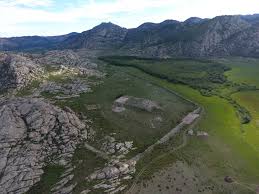
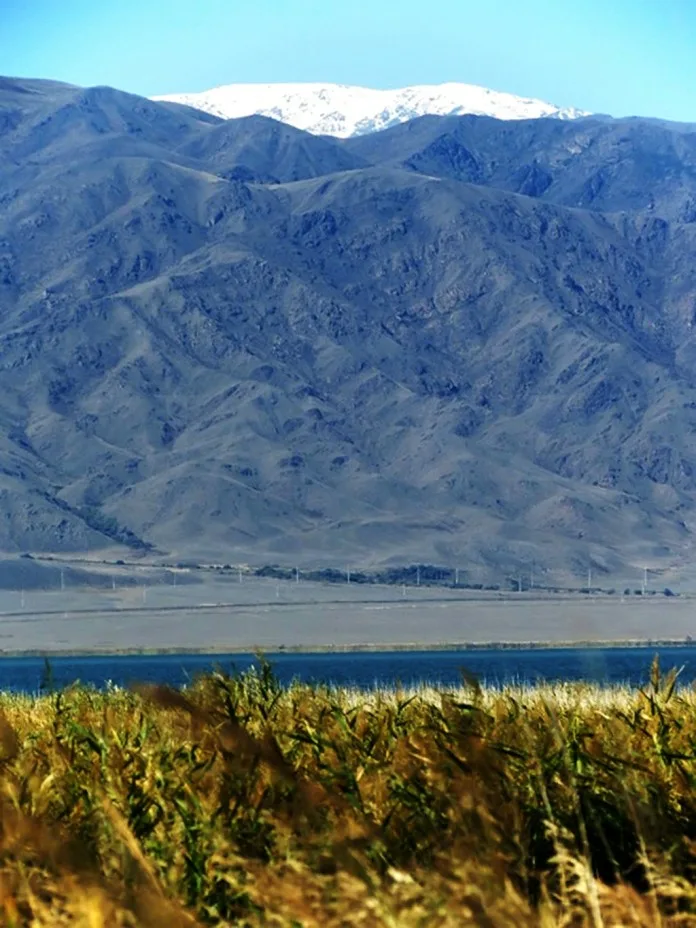
The Dzungarian Gate is a large mountain pass located between the Dzungarian Alatau Mountains in the west and the Barlyk Ridge in the east. It connects the Balkhash-Alakol Basin with the Dzungarian Plain. This natural corridor is about 50 km long and more than 10 km wide. The state border between Kazakhstan and China passes through this area. The elevation of the pass is approximately 300–400 meters above sea level.
On the northern side of the gate are Lake Alakol and Lake Zhalanashkol, while Lake Ebinur is located to the south. In the central part of the pass lies Kazakhstan’s Dostyk railway station, and in the southern part is China’s Alashankou station on the Lanzhou–Xinjiang railway line.
The climate of the region is dry, and semi-desert landscapes dominate the area. Due to its long and narrow shape, the Dzungarian Gate acts as a natural aerodynamic tunnel. Air passing through the corridor becomes compressed and accelerates according to Bernoulli’s law, which causes extremely strong winds. In some cases, wind speeds reach up to 70 m/s.
The dry and warm southeastern wind blowing from the Chinese side during cold seasons is called the “Ebi” wind. The northwestern wind coming from the Kazakh steppes is known as the “Saikan” or “Kubyla” wind. While the Ebi wind is usually dry and warm, the Saikan wind is more humid and often brings weather changes and rainfall. These two winds constantly replace one another, creating a unique “wind corridor” effect in the Alakol region.
During summer, northern winds are more common, while southern and southeastern winds dominate in autumn and winter. Because of the Ebi wind, strong storms often occur on Lake Alakol, where wave heights can reach 4–5 meters. This creates danger for birds nesting on the islands.
According to the famous scientist V.A. Obruchev, the local winds, although relatively warm, are extremely powerful. They can carry small stones through the air and make transportation very difficult. In some years, storms have torn roofs off houses, uprooted trees, overturned heavy machinery and trucks, and damaged power lines. There have also been cases of freight train wagons overturning along the railway. On January 28, 1958, a record wind speed of 70.5 m/s was officially recorded in this region.
According to UN experts, the Dzungarian Gate is one of the most promising areas for the development of wind energy. For this reason, Kazakhstan planned the construction of wind power plants near Alakol. Similar projects have been operating on the Chinese side since 2009.
Historically, the Dzungarian Gate has long been an important transportation route. The famous Silk Road once passed through this corridor. In the early 13th century, Genghis Khan used this route during his conquest of Central Asia.
In Russian literature, the term “Dzungarian Gate” was first used in 1875 by Ivan Vasilyevich Mushketov. In addition, on August 13, 1969, a border conflict occurred near the pass between Soviet border guards and Chinese military forces.
Between 1954 and 1990, a railway connecting the transport networks of Europe and Asia by the shortest route was built through this pass. The railway followed the route Aktogay – Dostyk – Alashankou – Ürümqi, forming the central corridor of the Trans-Asian Railway.
An interesting fact is that one of the continental points farthest from the World Ocean — the so-called pole of inaccessibility — is located near the Dzungarian Gate.
Source: ru.wikipedia, silkadv.com