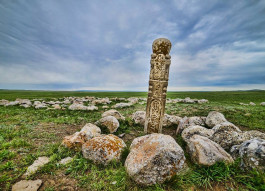
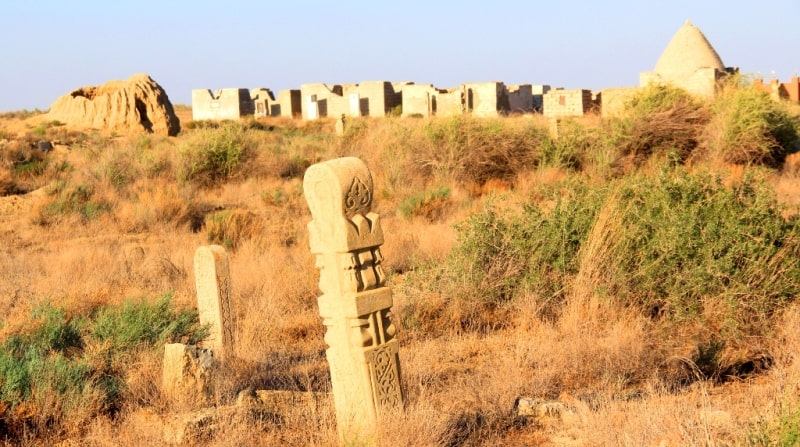
Ushkan Ata Necropolis is a unique architectural and memorial complex that occupies a special place among the historical and cultural heritage sites of the Atyrau Region of Kazakhstan. The monument is located in the Zhylyoi District, approximately 50 kilometers southeast of the city of Kulsary. The necropolis was formed over a long period, from the 14th to the 20th centuries, and is currently included in the list of historical and cultural monuments of local significance in the Atyrau Region.
The Ushkan Ata Necropolis is renowned for its remarkable architectural features, ancient tombstones, and outstanding examples of traditional Kazakh stone-carving art. The complex includes mausoleums, saganatams (memorial tomb structures), four-cornered enclosures, qoytas stones, sandyk-tas monuments, and more than one hundred gravestones. Research has identified 8 saganatams, 94 tombstones, 3 qoytas monuments, and 1 sandyk-tas within the site.
The most distinctive feature of the necropolis is its elaborately carved tombstones, which stand out for their variety of forms, intricate ornamentation, and high artistic quality. Because of these characteristics, the monuments of Ushkan Ata have become the subject of numerous archaeological and historical studies.
The prominent researcher of the Aral-Caspian architectural heritage, S. E. Azhigali, classified the tombstones of Ushkan Ata into three main groups. The first group includes large monuments dating from the mid-18th to the early 19th century, decorated with deeply carved ornaments. The second group consists of mid-19th-century tombstones that combine relief ornamentation with epigraphic inscriptions. The third group includes monumental pillar-shaped gravestones erected in the late 19th and early 20th centuries, reaching heights of 2.5 to 3.7 meters.
Researcher M. M. Mendikulov established that many of the region’s tombstones were created by the renowned stone masters Eleusin and Elbosyn Yegisinov, who lived during the late 19th and early 20th centuries. According to scholars, such unique monuments are found only in the Ushkan Ata and Karashungil necropolises located in the valley of the Zhem River.
Most of the tombstones were carved from shell limestone quarried in the northwestern part of the Ustyurt Plateau. The oldest examples were assembled from several sections, while later monuments were skillfully carved from single blocks of stone. Traditionally, the tombstones consist of three parts: a lower base, an ornamented column, and an upper decorative sculptural element, which researchers conventionally refer to as a capital.
The artistic value of these monuments lies in their complex multi-layered composition. Some tombstones are crowned with geometric forms resembling hemispheres, truncated pyramids, or trapezoids. Their decorations feature traditional Kazakh ornaments such as “Koshkar Muiz” (ram’s horn), “Tuye Taban” (camel’s footprint), and “Qus Kanaty” (bird’s wing). In addition, images of weapons, household items, tribal tamgas, and epigraphic inscriptions written in Arabic script can be found on many of the monuments.
After studying the inscriptions and tribal symbols, S. E. Azhigali concluded that the necropolis primarily contains the burials of representatives of the Kete, Adai, and Shekti clans of the Junior Zhuz.
The history of Ushkan Ata extends far beyond the medieval period. Historical evidence indicates that an important caravan route once passed near the necropolis, linking the Lower Volga region with Khorezm and Khiva. This route was one of the branches of the Great Silk Road. During the Middle Ages, the nearby city of Trestargo, dating from the Golden Horde period, was located in this area.
In 1732, the Russian officer I. Gerber visited the region and recorded the presence of the necropolis, as well as the ruins of a medieval city and a caravanserai built from fired red brick. These records suggest that the Ushkan Ata area was once an important trade and cultural center.
Several theories explain the origin of the necropolis’s name. One legend associates it with a story about a man capable of flying. Another theory suggests that the name evolved from the phrase “Ush Akkan” (“Three Springs”), referring to three streams that once flowed nearby. Folk traditions also connect the name with the bloodshed that occurred during the Kazakh–Kalmyk conflicts of the 18th century.
According to historians, a mosque stood near the necropolis before the October Revolution. However, it was destroyed during the early decades of the 20th century. Local oral traditions also mention mysterious lights that were said to appear at night in the center of the cemetery.
For many years, Ushkan Ata remained outside the scope of large-scale archaeological investigations. Only in recent decades have systematic scientific studies been conducted. In 2021, archaeologists discovered 23 coins from the period of the Jochi Ulus (Golden Horde). Among them were copper and silver coins minted during the reigns of Uzbek Khan, Janibek Khan, Khizr Khan, and Murid Khan. These findings confirm the close connections between the local settlement and the major political and economic centers of the Golden Horde.
Recent excavations also uncovered the remains of a medieval structure on a mound measuring approximately 150 by 150 meters. Archaeologists identified several rooms, wall fragments, traces of thresholds, alabaster plaster, ceramic bricks, and decorative facing elements. Researchers believe that these structures date back to the 14th century.
Archaeologists further suggest that the eastern part of the complex once contained mausoleums and burial structures decorated with ornamental bricks. Most of these monuments, however, have not survived. As a result, the Ushkan Ata complex remains an important site requiring further archaeological and historical research.
Today, the Ushkan Ata Necropolis is regarded as one of the most valuable monuments preserving the historical memory and spiritual heritage of the Kazakh people. Its tombstones and architectural structures provide invaluable insight into the history, worldview, artistic traditions, and religious beliefs of the populations that inhabited the Caspian region over several centuries.
Source: ruh.kz