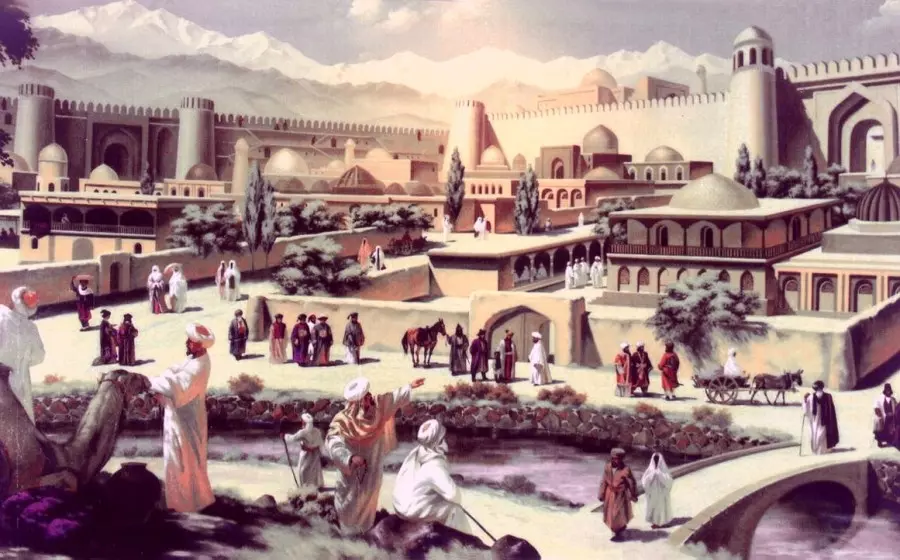
Taraz - is a memory of ancient times, a city that holds a special place at the highest level of human culture. This city, with more than two thousand years of history, combines its sacred meaning and legacy like the two strings of a dombra, creating a unique harmony. It can be said that the culture and art of the Great Steppe originate from this land.
The records of Mahmud al-Kashgari, Xuanzang, Rubruck, and other medieval scholars and travelers confirm that Taraz is an ancient city. In the poetry of famous Eastern poets such as Saadi and Jami, the beauty of the Talas region and the image of girls in moonlit nights are described at a highly poetic level. These are - unique poetic images of world literature.
According to historical sources, in ancient times this region was under the influence of the Xiongnu Empire. Chinese chronicles mention that one of the first cities along the Talas River was built around the 4th century BC by Shöje, one of the last rulers of the Xiongnu. However, this city was soon destroyed by Chinese forces. Despite its destruction, trade routes in the region continued to exist, and the area once again became an important center.
From the 7th century, Taraz became a major trading center along the Great Silk Road. The city turned into an important hub of international trade and cultural exchange.
Historical records state that in 508, the Byzantine envoy Zemarch negotiated with Khan Estein in Taraz. In 751, the famous Battle of Atlakh took place near Taraz, ending in victory for the Arabs and Karluks. During the Karakhanid period, Taraz experienced its spiritual and cultural peak. In the 10th-12th centuries, the city became one of the largest political, economic, and cultural centers of the Turkic world.
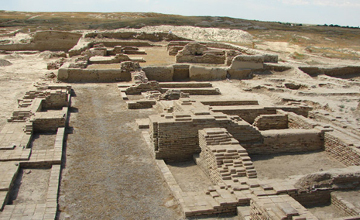
Many scholars have studied the history of Taraz. Alexander Bernstam noted that the city developed during the Samanid-Karakhanid period, while Lazar Rempel described the complexity of archaeological layers. Excavations carried out by Kallaur (1904), Masson (1927), and Rempel (1950) also confirmed the high level of urban culture. Some of the discovered artifacts were sent to Tashkent and Leningrad.
Archaeological research shows that cities such as Khmukent, Lower Barskhan, Zhikil, Adakent, Kulan, Merke, Aspara, and Balasagun once existed around Taraz. However, only Taraz has survived to the present day.
Nevertheless, the history of the city has not yet been fully studied. Scholars interpret historical data differently, and there is still no unified comprehensive work. Therefore, studying the historical figures and cultural layer of Taraz remains important.
Today, centers such as “Bauyrzhantanu” and “Sherkhantanu” are operating, but there is no specialized center dedicated to the study of Taraz’s history. If such a center were established, many unknown pages of the ancient city could be revealed.
Previously, historians such as Bakhtiyar Abildauly and Kuzembay Baibosynov studied the city’s history, but their work was not continued.
Statements by the First President, such as “Taraz is the backbone of our history” and “Taraz is the golden pillar of our spiritual heritage,” highlight the city’s significance.
Today, many secrets are still hidden in Taraz. Some archaeological layers lie several meters underground, but systematic excavations are not being carried out sufficiently. Modern buildings have been constructed over some historical sites.
It is known that during the Soviet period, many historical artifacts were taken outside the country, and their current locations are unknown.
There are also reports of attempts to remove valuable artifacts from the Aisha Bibi mausoleum, but these actions were stopped thanks to the intervention of responsible officials.
In conclusion, a deep study of Taraz’s history is a necessity of our time. Every corner of the city preserves traces of the past. With a systematic scientific approach, many secrets of this ancient city will certainly be revealed.
Source: egemen.kz