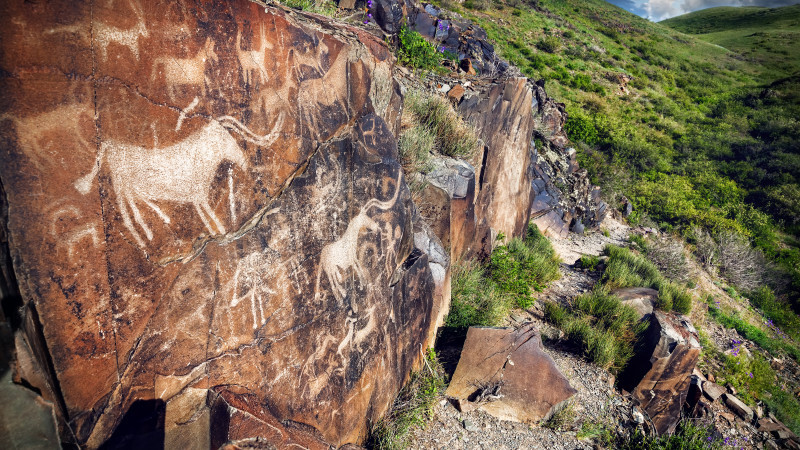
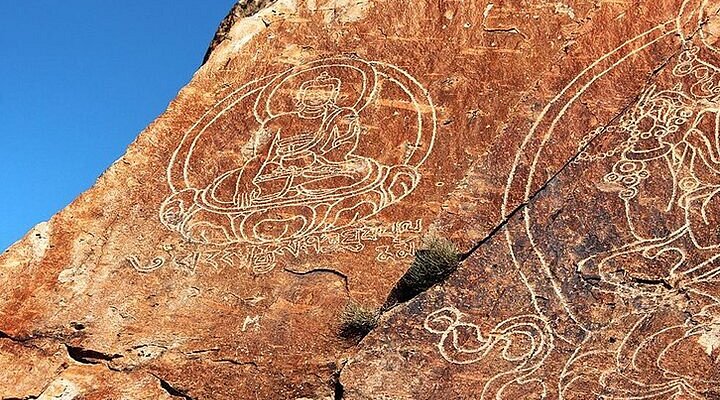
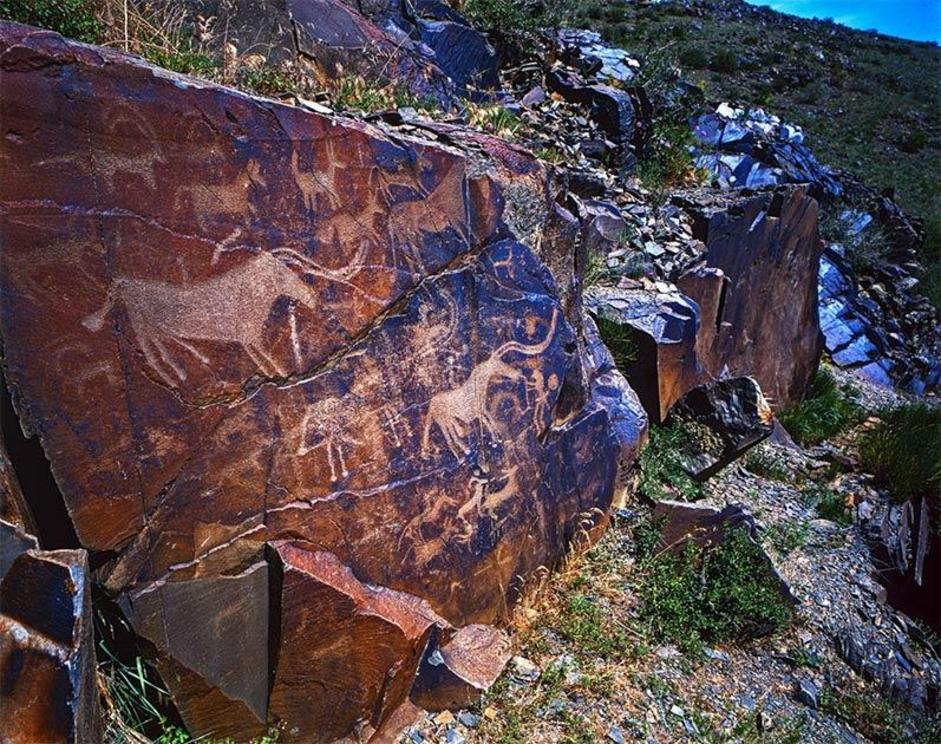
The Tamgaly Petroglyphs are a rock art complex and one of the oldest monuments of Zhetysu. Since 2004, it has been included in the list of UNESCO World Heritage Sites in Kazakhstan.
The Tamgaly gorge rock gallery was discovered on 19 September 1957 by the Zhetysu expedition of the South Kazakhstan archaeological team of the Institute of History and Archaeology of the Academy of Sciences of the Kazakh SSR, led by Kazakhstan’s first professional archaeologist Anna G. Maksimova. Although the petroglyphs were found accidentally, the discovery was extremely significant, as one of the ancient human settlements in Kazakhstan was later recognized as part of the UNESCO World Heritage List.
Over the past decades, numerous scientific expeditions have been conducted here, and every field season researchers discover new evidence of ancient life. Today, the reserve covers an area of about 3,800 hectares and includes settlements, burial sites, stone carvings, rock art galleries (more than 5,000 images in total), and ritual structures such as sacrificial sites. These monuments span from the 14th–13th centuries BCE to the 19th–20th centuries CE, showing continuous human presence in the region for thousands of years. Evidence includes stone dwellings, animal enclosures, pottery fragments, and tools made of stone, bone, and metal.
The petroglyphs are among the most important and diverse monuments of Tamgaly. They were created using the pecking technique (pictogram engraving), and no painted images have been found. The rock art was produced in different historical periods: the Middle Bronze Age, Late Bronze Age, Early Iron Age (Saka and Usun), the Medieval Turkic period, and even later epochs such as the Jungar and Kazakh periods. The most ancient and artistically significant group belongs to the Middle Bronze Age, featuring complex symbolic compositions such as sun-headed deities (“sun worshippers”), masked figures, warriors, scenes of sacrifice, erotic and ritual scenes, as well as animals like bulls, horses, camels, deer, wolves, and boars.
The Tamgaly gorge is located about 170 km northwest of Almaty, in the southeastern part of the Shu-Ili mountains. The petroglyph area extends over approximately 3 km × 10 km, with the main concentration of around 2,000 rock carvings in a 250 m × 500 m zone.
Tamgaly is considered one of the most significant archaeological centers not only in Central Asia but also on a global scale. The petroglyphs reflect the ancient worldview of people and their perception of the universe. In 2004, Tamgaly was officially inscribed on the UNESCO World Heritage List. Since 2006, UNESCO has been actively involved in supporting its preservation.
The surrounding area also contains Bronze Age burial mounds (14th–10th centuries BCE), as well as settlements of early nomads (3rd–2nd centuries BCE). The gorge is also rich in wildlife and plants, including wolves, foxes, rabbits, snakes, and birds of prey such as falcons and eagles.
Tamgaly is not only a natural landscape but also an open-air museum of ancient creativity, where humans expressed their worldview through rock art. The site continues to be an important cultural, scientific, and historical heritage monument protected at the international level.
Source: qazaqstan3d.kz