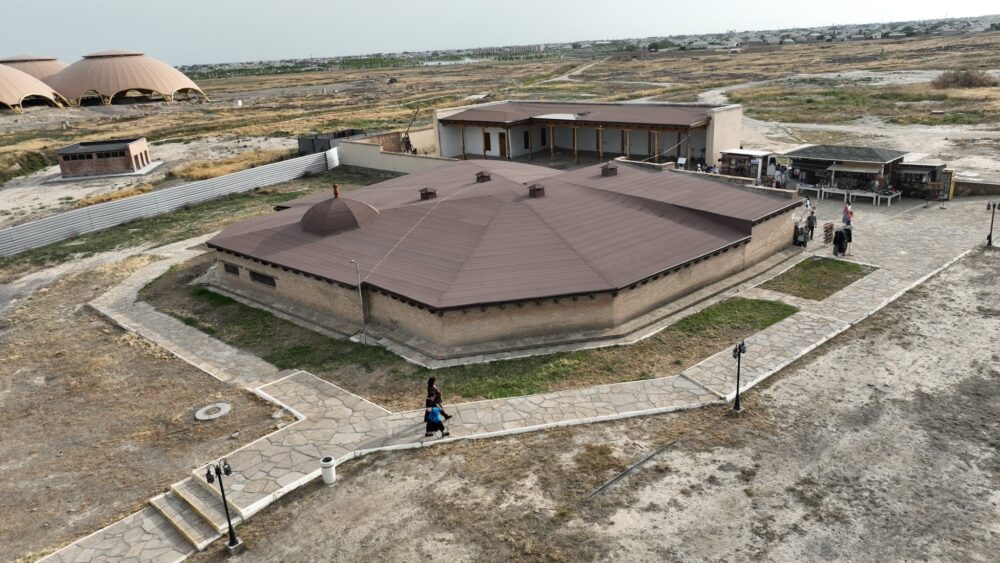
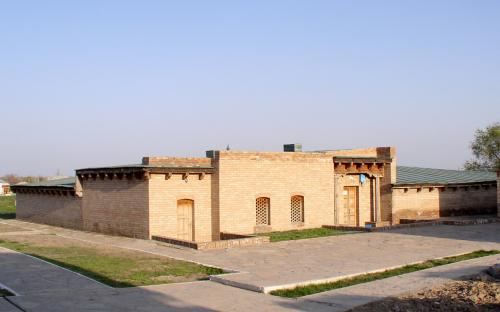
The Khilvet underground mosque is one of the oldest and most unique spiritual and architectural monuments in the city of Turkistan, built in the 12th century. It is included in the list of monuments of national significance and belongs to the “Azret Sultan” National Historical and Cultural Museum-Reserve. Khilvet is located about 120 meters south of the Khoja Ahmed Yasawi Mausoleum.
The word “Khilvet” comes from the Arabic concept “khalwatun”, which means seclusion and solitude. In the Sufi tradition of Islam, it refers to a place where a person isolates themselves from worldly affairs and performs spiritual practices to become closer to the Creator. The main religious practice performed here was zikr (remembrance of God).
According to researchers, when Khoja Ahmed Yasawi reached the age of 63, the age of the Prophet Muhammad’s passing, he had this underground mosque built and spent the final years of his life there. He also taught his disciples in this place and wrote his famous works, including “Diwani Hikmet”, “Mirat-ul-Kulub” and “Paqirnama”.
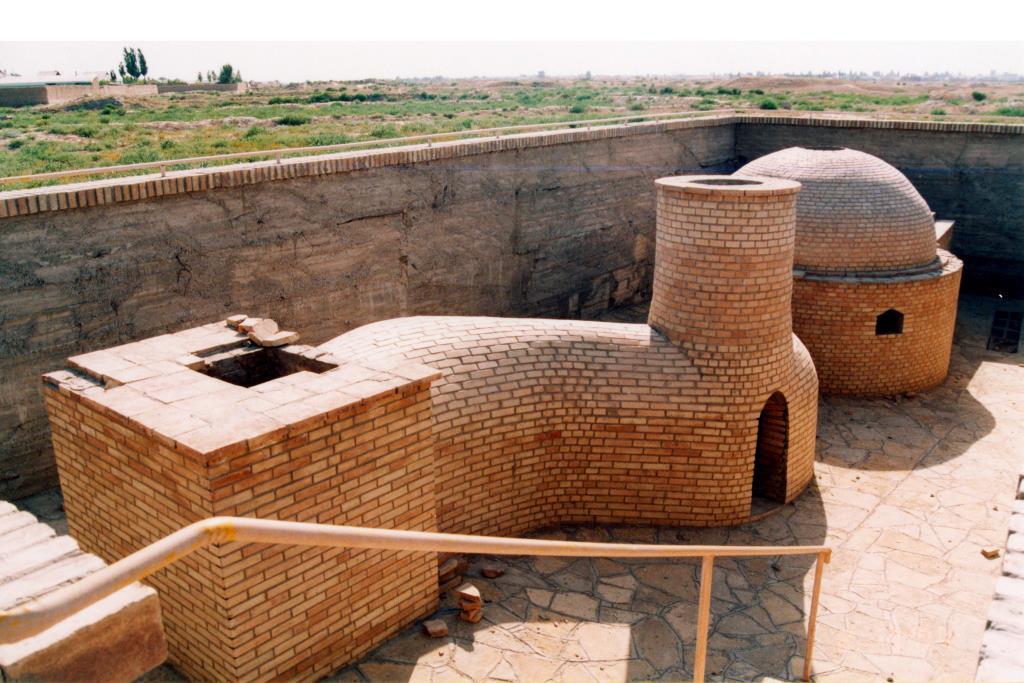
Originally, Khilvet was a complex consisting of 18 rooms. It included a community hall, a mosque, utility rooms, a kitchen, washing areas, and places for ablution. This shows that the complex served not only religious purposes but also educational and daily-life functions.
The most important part of the complex is the underground “Gar” chamber. It is located about 4 meters underground and was designed for one person. This room was built from baked bricks using the “Balkhi” construction method. The walls and dome of the Gar chamber have been preserved in a square structure and are considered the oldest surviving part of the building, dating back to the 12th century, the era of Yasawi.
The largest room of Khilvet is the Jamaatkhanа (community hall). It is the only room with windows and a central dome. Special niches for lamps were made in all rooms. The overall dimensions of the complex are: length – 20.9 meters, width – 14.7 meters, interior height – 4.8 meters, and height with the dome – 6.4 meters.
During the 20th century, Khilvet was damaged several times. During the Great Patriotic War, its bricks were used for other construction purposes. Later, archaeological studies were carried out in 1972–1973 and 1979, revealing its historical layers. The complex was restored based on the 1942 drawings of architect A. L. Schmidt.
Research has shown that Khilvet was built in several stages. The earlier parts date back to the 15th–17th centuries, while later expansions belong to the 18th–20th centuries. The oldest part, the Gar chamber, remains a unique architectural structure preserved from the 12th century.
Khilvet was not only an architectural monument but also an important center of Sufi teachings. During the winter spiritual retreat period (40 days), Sufis from Central Asia, the Caucasus, and Kazakhstan gathered here to perform zikr and spread Yasawi’s teachings. Some sources mention that 20–25 thousand people gathered in Turkistan during this period.
Today, Khilvet is a unique place preserving spiritual tranquility and historical memory. It is considered a sacred site directly connected with the heritage of Khoja Ahmed Yasawi and remains a place visited by pilgrims and those interested in the spiritual history of Kazakhstan.
Source: azretsultan.kz, kozhalar.kz