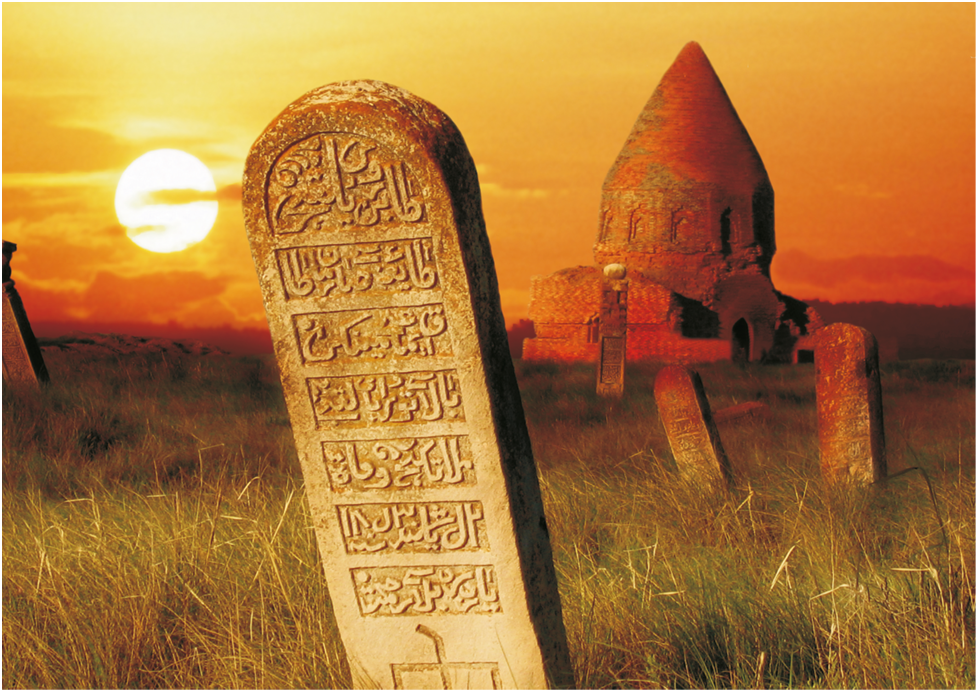
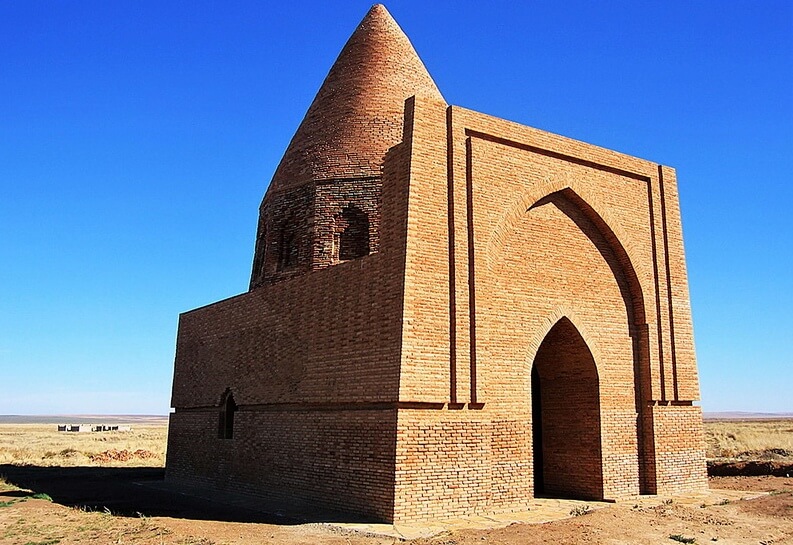
Abat-Baytak Mausoleum is an important architectural monument built in the late 14th - early 15th century. It is located in the Aktobe Region, Kobda District, about 12 kilometers south of the Taldysay settlement, in the Kobda River valley within the Abat-Baytak necropolis.
According to folk legends, the mausoleum was built in honor of Abat batyr, the son of the famous thinker and zhyrau Asan Kaigy. Abat batyr died suddenly in the Beskopa valley, and in his memory the people of the entire region quickly constructed this mausoleum. This is why the name “Baytak” (meaning vast, spacious) was added. However, its architectural features suggest that the structure reflects a high-status burial associated with nobility.
The mausoleum has a square base and is crowned with a conical dome placed on an 11-sided drum. The dimensions are approximately 9.52 × 9.8 meters, the original height reached 16 meters, and the preserved height today is 14.5 meters. It was built from unfired brick, with an interior plastered in clay and an exterior faced with fired brick.
Architecturally, Abat-Baytak Mausoleum belongs to the group of tent-like domed structures, and in some studies it is described as a portal-domed monument. The interior layout is also based on a square plan. The gradual transition of 8- and 16-sided forms toward the dome creates a visually balanced and light composition. The walls contain arched niches and decorative elements. In style, the monument is similar to Khorezm architectural traditions and such structures as Arslan, Tekesh, and Kök-Kesene.
The necropolis contains more than 200 gravestones (kulpy-tas), mostly carved from white and light-gray limestone. Their height ranges from 1.2 to 2 meters. Many of them bear Arabic inscriptions with names of the deceased, short biographies, and tribal symbols. These stones reflect the craftsmanship of Kazakh artisans from the 18th-19th centuries. The necropolis is under state protection.
The mausoleum was first recorded in the 19th century by the expedition led by French traveler Joseph Castagné. In the 20th century, research was continued by historian Mukhamedkazy Mendyqylov, and in 1979-1980 it was studied by an expedition of the “Kazrestavratsiya” organization under Serik Azhigaliyev. Restoration work was carried out in 1983.
Research indicates that the original façade was about 3 meters thick and around 5 meters high, while the total height of the structure reached 16 meters. It is also suggested that the upper part of the mausoleum may have been decorated with gold-colored ornaments to make it visible from a distance.
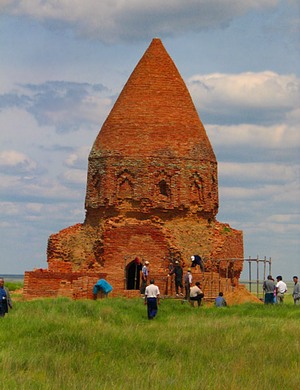
Later, the mausoleum was reconstructed while preserving its original architectural form. A small brick factory was even opened in the Kobda district to produce bricks using medieval techniques for the restoration.
It is also noted that a replica of the Abat-Baytak Mausoleum was found in the Chelyabinsk region of Russia, although it was reconstructed during the Soviet period.
In 2007, the mausoleum was restored again and included in the list of nationally significant cultural monuments. Approximately 30 million tenge was allocated for its preservation.
Source: inform.kz