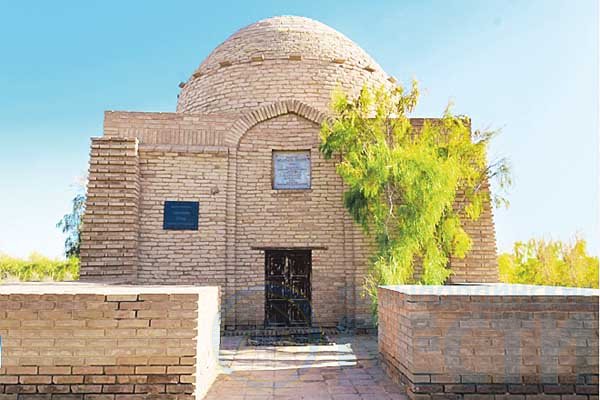
The mausoleum of Oqshy Ata is an ancient historical monument that has survived to the present day. It is located in the Shieli district of the Kyzylorda region. Although the structure is relatively small, it holds great historical and spiritual significance. Its architectural origins are generally attributed to the 9th-10th centuries. Many legends and oral stories are associated with this sacred place.
According to one legend, Oqshy Ata was originally known as Kögentüp, while his religious name was Ibrahim Sheikh. He lost his parents at an early age and was raised by an elderly couple who had a single daughter. As he grew up, he became a hardworking man, engaged in farming, and supported his foster family. At the same time, he was known as a highly skilled archer and a brave warrior.
A well-known legend tells that during that era, a Kalmyk khan imposed harsh rule over the people and demanded heavy tribute. At a critical moment, the khan attempted to take away Kögentüp’s sister. Hearing the cry and the neighing of a horse, he took an arrow made from a barley stalk and struck the khan, saying: “This is an arrow sent by God.” The arrow hit directly in the heart, and the khan died, freeing the people from oppression.
Later, a dispute arose among the people about who had killed the khan. Kögentüp asked them to specify where the fatal wound had been inflicted. After learning it was in the heart area, he said: “If barley is found in the wound, then it was my arrow.” When the wound was examined, people confirmed that the khan had indeed been killed by an arrow made from barley stalk. From that moment on, the people began calling him Oqshy Ata.
Legends also say that he possessed extraordinary abilities: he could see very distant objects and find lost livestock. Because of this, villagers often turned to him for help.
According to researchers, the area around the mausoleum was once an important spiritual center during the Oghuz and Kipchak eras. Many saints and historical figures were buried there. These include Asan Ata, Kysh Ata, Ghaib Ata, Kitab Ata, Qabyl Ata, Yesabyz Ata, and Dosbol bi. It is believed that the burial site of Asan Ata is connected to the legendary figure Asan Kaigy, and since 1992 it has been placed under state protection.
According to scholar Auelbek Konyratbayev, Oqshy Ata was a warrior and weapon craftsman serving under Khan Kazan Salor. It is also stated that he died in 1043 and was buried at the site of the present-day mausoleum. Some sources associate him with the spread of Islam among the Turkic peoples.
Researchers suggest that a settlement may have existed in this area in ancient times. Although precise historical data is limited, the Oqshy Ata mausoleum remains an important witness to the region’s ancient civilization and continues to be studied.
Source: el.kz