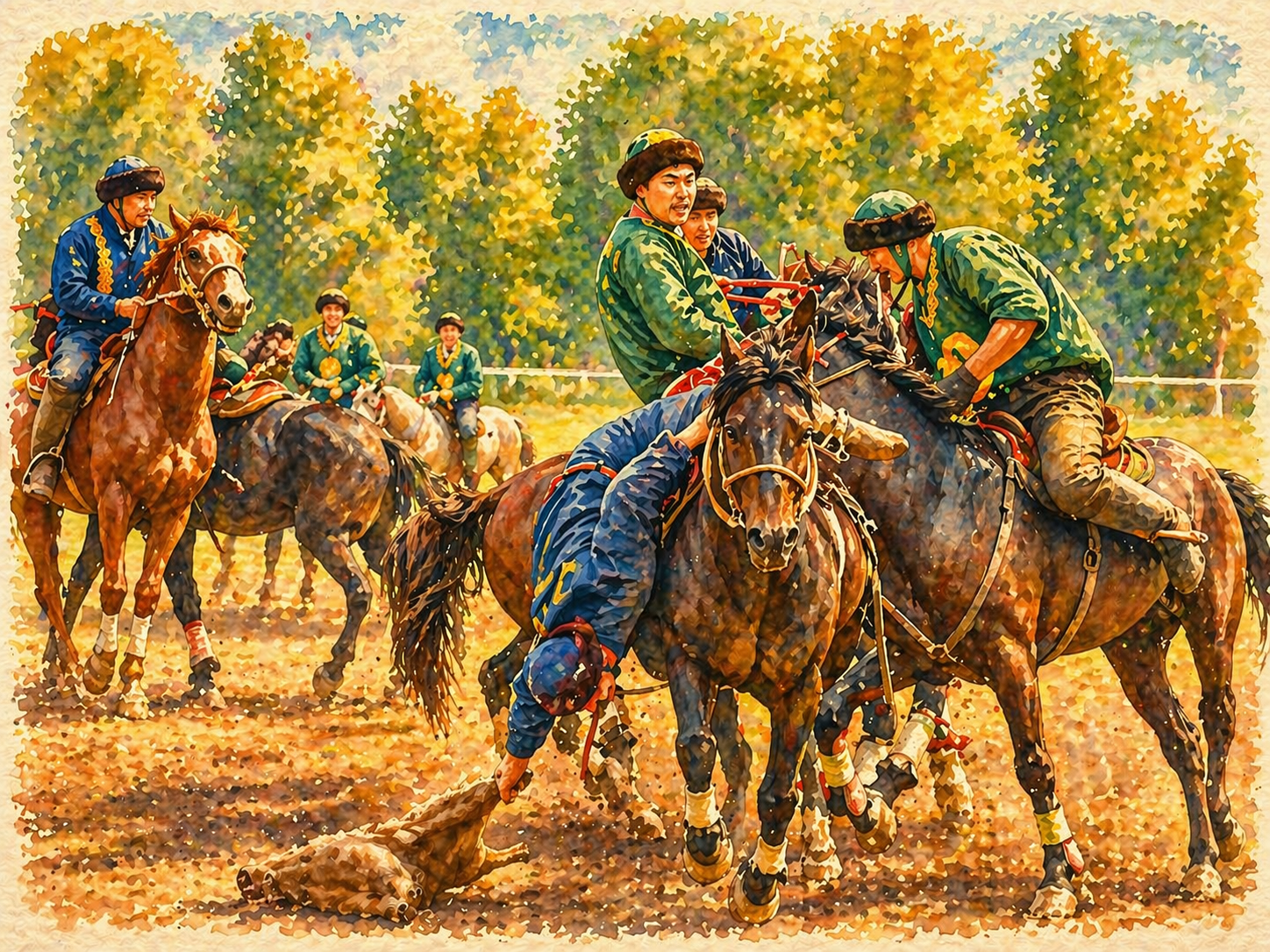
National sports are an essential part of Kazakhstan's cultural heritage and a brand for the country on an international level. Since ancient times, the Kazakh people organized competitions during holidays and important gatherings that tested the agility, strength, and spirit of the participants. Today, these sports are experiencing a revival and are becoming particularly popular among the youth.
History of the Origin of Kazakh National Games
Kazakh national games are closely linked to the nomadic way of life. They developed in accordance with the needs of their time. For example, horse racing (at bäygesi) and wrestling (küres) were considered part of the martial arts, while the games toğızqumalaq and asıq were aimed at developing strategic thinking and physical mastery.
Professor Aitkoja Orazbaev, a scientist who deeply researched the historical significance of national games, wrote: "Our national games are the cultural heritage of the people; they define our philosophy of life. Every game has its own history and meaning; they reflect various aspects of the people's life."
Kazakh national games play an important role in the social life of the people. They are widely used in festive events, in the upbringing of youth, and in strengthening the cultural unity of the nation. These games help preserve the history and traditions of the people and also allow national values to be passed down from generation to generation.
Equestrian Sports
Since the steed (tulpar) occupied a special place in the daily life and lifestyle of the Kazakh people, horse competitions are of immense importance:
- Kökpar: A sport with deep roots, requiring strategic and physical preparation. Two teams on horseback struggle for a goat carcass, trying to take possession of it and throw it into the opponent's "kazan." Kökpar is an extreme sport that combines strength, endurance, and horse-handling skills.
- Bäyge: The most ancient and popular form of equestrian sport. Races are held on both flat terrain and cross-country. Here, the rider's ability to assess the situation and correctly calculate the horse's strength plays a crucial role. The game fosters endurance, resourcefulness, and courage.
- Audarıspaq: Wrestling between two riders on horseback. The goal of the competition is to pull the opponent out of the saddle or throw them off the horse. This sport requires exceptional strength, balance, and agility.
- Jambı atu: An ancient game that tests agility and marksmanship. Participants must hit a target (jambı) mounted on a pole with a bow while at a full gallop.
Traditional Wrestling and Intellectual Games
- Qazaqşa küres: One of the most widespread types of national sports. Athletes use various techniques to throw their opponent onto their shoulder blades. Currently, qazaqşa küres is recognized at the international level, with republican and world tournaments held regularly.
- Toğızqumalaq: A Kazakh national logical board game. It develops mathematical thinking, trains tactical decision-making, and fosters patience. During the game, the four basic mathematical operations are used, which earned it the name "algebra of the steppes."
- Asıq atu: A game directly linked to nomadic life and animal husbandry. It develops accuracy, eye coordination, and calculation skills in children and adolescents, while also contributing to the strengthening of the nervous system.
The Art of Hunting and Combat Sports
- Hunting with birds of prey (Qusbegilik): The art of training and using birds of prey, such as the golden eagle and the saker falcon, for hunting. This is not only a sport but an ancient tradition demonstrating the harmony between man and nature. In competitions, the qusbegi (master eagle hunters) are judged on the bird's speed and its obedience to the owner.
- Jekpe-jek: A type of sport that takes into account individual mastery, physical fitness, and the participants' points. It combines elements of national wrestling and modern methods of combat sports.
Kazakh national games are the foundation of the people's cultural heritage. They are an important tool designed to preserve the history, traditions, and cultural values of the nation. The role of national games in the upbringing of youth is immense. They help develop physical activity, strategic thinking, and teamwork skills, while also passing down the national culture from generation to generation.