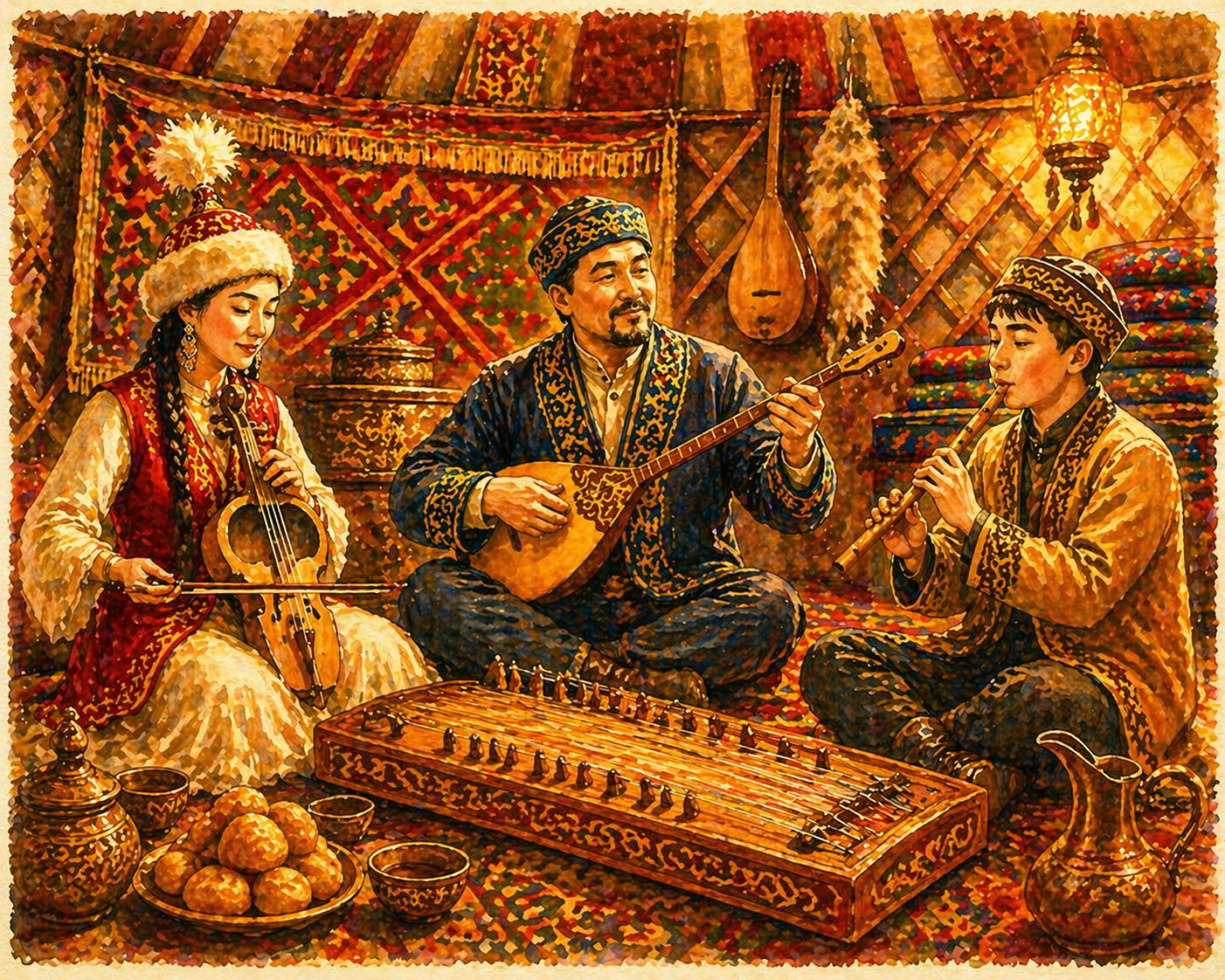
Kazakh national musical instruments represent a unique cultural heritage that reflects the spiritual world of the people, their worldview, and historical memory. They are not merely tools for producing sound, but a vivid expression of the nomadic way of life, harmony with nature, and the inner emotional landscape of the Kazakh people. These instruments are traditionally classified according to the method of sound production into several main groups:
String instruments
Dombra is the most widespread and symbolic instrument of the Kazakh people. It has two strings and is typically made of wood. The dombra is played by plucking, producing a warm, deep, and expressive sound. Through kyui performed on the dombra, historical events, heroic narratives, natural landscapes, and human emotions are conveyed. The art of dombra performance has evolved over centuries, giving rise to distinct regional schools.
Qobyz is one of the oldest bowed instruments. Its strings are made of horsehair and sound is produced using a bow. The tone of the qobyz is deep, often mournful, and carries a mystical quality. Historically, it was widely used by shamans and storytellers, which is why it is regarded not only as a musical instrument but also as a spiritual one with special significance. Music performed on the qobyz is often connected to themes of nature, life, and death.
Zhetygen is a multi-string instrument whose strings are tuned using special movable bridges, allowing precise pitch adjustment. Its sound is soft, delicate, and lyrical. According to legend, the zhetygen was created as a means of expressing grief and loss, which gives its music a deep emotional character. Today, it is also widely used in ensemble performance.
Sherter is a string instrument similar to the dombra, but smaller in size and sometimes featuring three strings. It is also played by plucking. The sound of the sherter is soft, muted, and warm, and it is most often used to accompany folk songs. Its compact size and ease of use are among its distinguishing features.
Wind instruments
Sybizgy is one of the oldest wind instruments, traditionally made from reed or wood. It has several finger holes and produces a clear, pure sound reminiscent of natural tones. It was especially popular among shepherds, who used it to express their emotions while in nature.
Sazsyrnai is a small wind instrument made of clay. It typically has a rounded or oval shape with several holes. Its sound is gentle, soft, and melodic. The sazsyrnai is often used in folk ensembles and is popular among children and young people.
Uskirik is a distinctive wind instrument, usually made of clay or bone. Its sound resembles the whistling of the wind. It is often used to imitate natural sounds and create atmospheric musical effects.
Kerney is a long and powerful wind instrument with a loud and ceremonial sound. It is used during celebrations, rituals, and historically in military contexts. Its main feature is its commanding and majestic tone.
Percussion instruments
Dabyl is a percussion instrument covered with leather, played with sticks. Its sound is strong and clear, which made it suitable for use in military campaigns, for signaling, and during ceremonial events.
Dangyra is a frame drum with metal jingles attached inside. It produces a rhythmic, ringing sound. Traditionally, it was used by shamans in ritual and healing practices.
Asatayak is a staff-like percussion instrument with attached metal elements that produce a light, jingling sound. It is used to provide rhythmic accompaniment in music.
Shyldyrmak is a small percussion instrument with a light and playful tone. It is often used in children’s games and for simple musical accompaniment.
Kazakh national instruments are primarily made from natural materials such as wood, leather, bone, and horsehair, which give them a distinctive organic sound. They are lightweight, portable, and well adapted to the nomadic lifestyle. Through these instruments, the Kazakh people have conveyed their history, emotions, and worldview. The art of kyui is closely connected to these instruments, as it allows for storytelling without words, expressing deep meanings and imagery through music.
Kazakh national musical instruments represent a unique cultural value that embodies the inner world of the people, their aesthetic sensibilities, and historical experience. Each instrument has its own distinct sound, character, and history, and continues to play an important role as an integral part of Kazakh culture today.