






 Қазақша
 Русский

The Nurata district in the Navoi region of the Republic of Uzbekistan is an area where ancient history and modern life are intertwined. Located along the main highway connecting to Jizzakh, this district has a population of nearly 50,000. According to archaeologists, traces of human settlements dating back approximately 40,000 years have been found near the town. The foundation of the settlement is linked to the Nur fortress, built in the 4th century BC, associated with the campaigns of Alexander the Great.
Today, Nurata is a thriving region of agriculture, marble production, and tourism. It is home to the Chashma pilgrimage site, the "Aiteke Bi – Seyitqul Aulie" complex, the Sentob tourism village, and ecotourism centers along Lake Aydarkul. Tourist numbers are especially high during the month of May.
Kazakhs are densely settled in the villages of Kosqudyq, Kyzylsha, Shuqurqudyq, Kozybayqudyq, and Temirqauyq within the Nurata district. In four schools across these settlements, students receive their education in their mother tongue. In total, 58 Kazakh schools operate in the Navoi region.
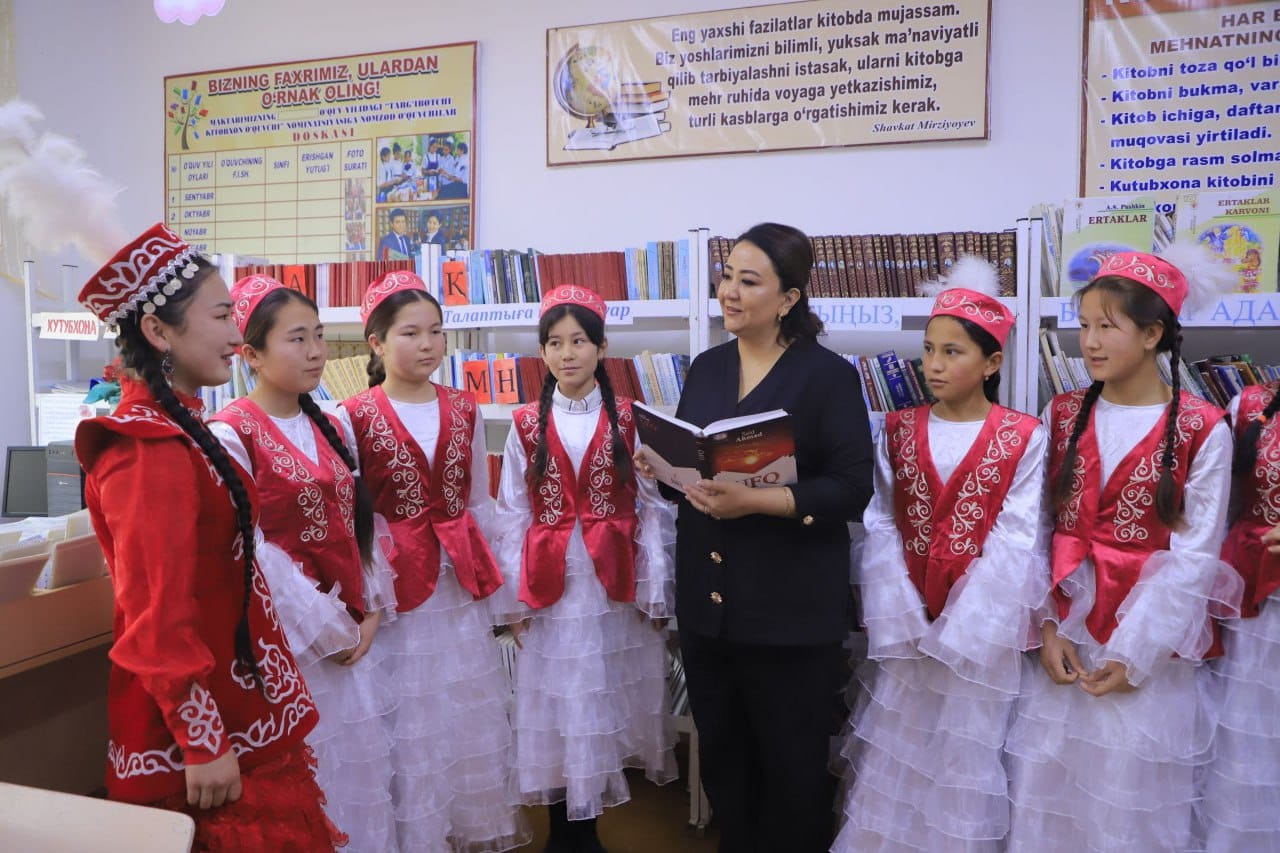
One of these is General Education School №23 in the remote village of Kosqudyq. Recently, K. Shamieva, the head of the Nurata District Department of Preschool and School Education, visited the school and met with students in the library in an informal setting. During the meeting, they discussed fostering a reading culture among youth, the impact of literature on personal development, and its role in broadening one's worldview.
Indeed, a book is a person's faithful companion. It not only expands the horizons of knowledge but also enriches vocabulary, helps organize thoughts, and assists in defining life principles. For students, reading is an effective way to spend leisure time meaningfully, going beyond the school curriculum.
The library of School №23 in Kosqudyq is well-stocked with works of Kazakh literature. As part of the "Gift a Book to the School Library" campaign held annually in April and May, alumni celebrating their 10th, 20th, 30th, 40th, and 50th anniversaries present books to their alma mater, enriching its spiritual treasure trove. This is a vivid example of the continuity between generations.
Kosqudyq has produced many talented individuals. Among them is Polat Qazybekov, a well-known poet in the Kyzylkum region and a biology teacher. The emergence of such figures testifies to the quality of education and upbringing provided in this village school.
Despite its remote location, the Kazakh school in Kosqudyq stands as a pillar of national spirit and education in the mother tongue. This is a significant milestone in the spiritual life not only of one village but of the entire Kazakh community abroad.
Author: Guldana Narynbetova, Journalist