





 Қазақша
 Русский

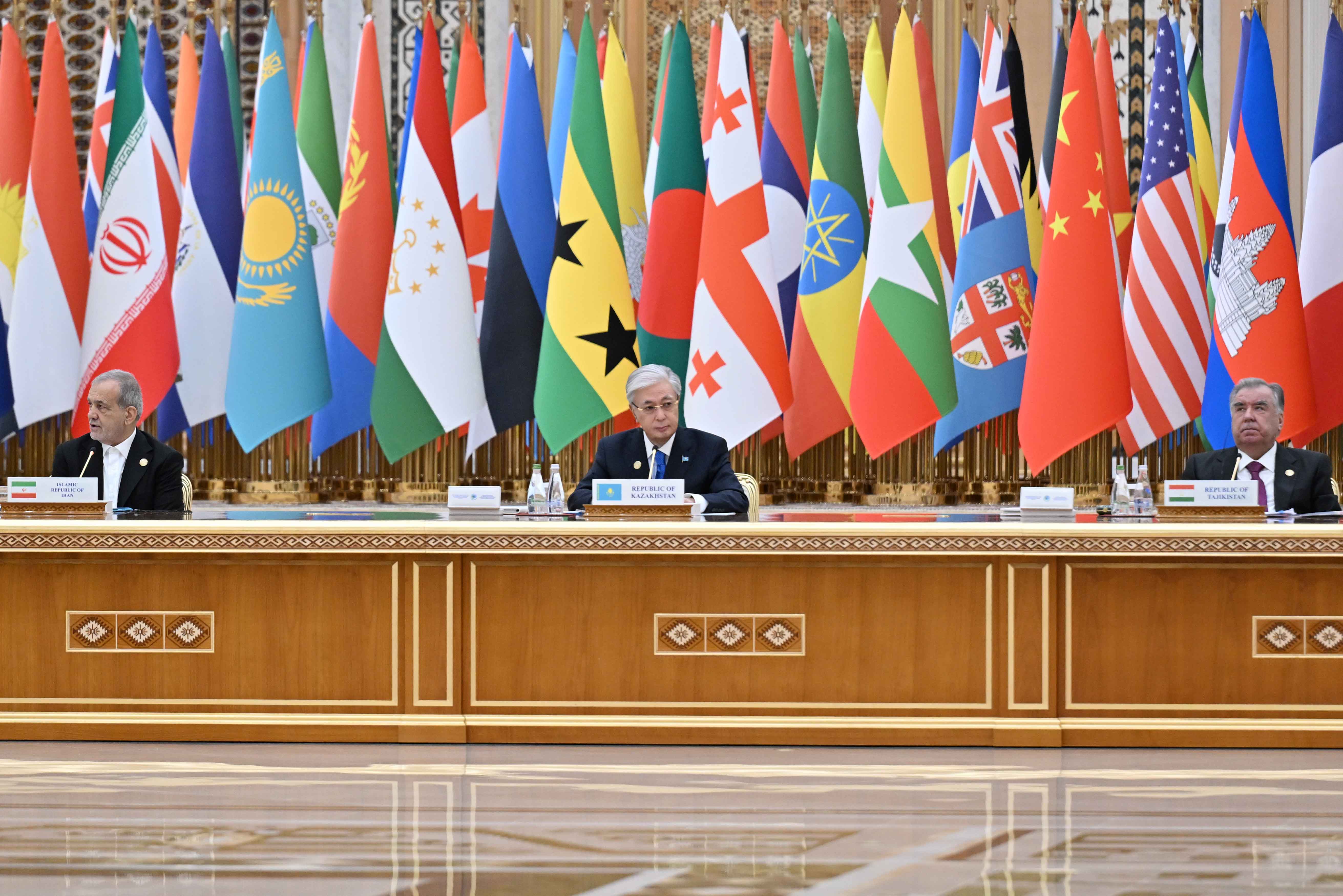
At the outset of his address, President Kassym-Jomart Tokayev congratulated the National Leader of the Turkmen people, Gurbanguly Berdimuhamedov, and President Serdar Berdimuhamedov on the 30th anniversary of Turkmenistan’s permanent neutrality.
The Head of State emphasised that the country’s political course has made a substantial contribution to stability and sustainable development across the vast expanse of the Eurasian continent. According to him, the proposals voiced during the Forum are intended to demonstrate anew the significant positive role of neutrality in the 21st century.
The President of Kazakhstan underlined that Turkmenistan’s policy of positive neutrality is organically rooted in the centuries-old cultural traditions and spiritual values of the Turkmen people.
“As the founder of Turkmen classical literature, the outstanding thinker Magtymguly Pyragy, once said: ‘Where there is peace, the state grows stronger; where there is justice, trust flourishes.’ The ideas of the great humanist Magtymguly essentially constitute a unique philosophical concept whose relevance in today’s complex international realities is beyond doubt,” Kassym-Jomart Tokayev stated.
The Head of State highlighted the particular significance of Ashgabat’s initiative to proclaim the International Year of Peace and Trust, which was supported by the United Nations General Assembly. The President noted that Kazakhstan had joined this important resolution, as peace and trust form the fundamental basis of Kazakhstan’s foreign policy strategy.
“Despite successes in resolving certain conflicts, the overall global situation remains extremely tense. There is a shortage of such critically important factors as mutual trust, tolerance, and an understanding of the importance of peace and cooperation for sustainable development. With great regret, we must also note the erosion of international law, its substitution by so-called ‘rules’, and, of course, the decline in the authority and effectiveness of multilateral institutions, above all the United Nations. Without the restoration of strategic balance and the construction of a just world order, international stability and security may remain nothing more than figures of speech and good intentions in negotiations and resolutions of multilateral forums. Therefore, Kazakhstan advocates reform of the United Nations, including the expansion of the Security Council and the strengthening of the role of the General Assembly. Within the framework of the 80th session of the General Assembly, I proposed the establishment of a ‘group of like-minded states’ to prepare concrete proposals for reforming the UN system,” Kassym-Jomart Tokayev said.
The President of Kazakhstan considers it important for major powers, by demonstrating political will, to call upon UN Member States to embark on a large-scale dialogue. Kassym-Jomart Tokayev also expressed Kazakhstan’s support for the initiative voiced today by the Head of Turkmenistan to establish a United Nations University of Peace and Neutrality.
“It has now become clear that a just and sustainable world order will only become a reality when narratives of inevitable global confrontation and even nuclear war are rejected, and when the lexicon of peace, trust and cooperation replaces militaristic rhetoric. In this regard, Kazakhstan welcomes the intensification of the negotiation process on the Ukrainian conflict. Following the meeting of the Presidents of Russia and the United States in Anchorage, the key provisions of a peace pact are being actively discussed, indicating the emergence of an opportunity to achieve long-awaited peace,” the Head of State noted.
Kassym-Jomart Tokayev then expressed support for the settlement of conflicts in other regions.
“We welcome the signing of an agreement on the situation in the Middle East. Kazakhstan’s decision to join the Abraham Accords is driven by the desire to make a tangible contribution to stabilising the situation in this region. At the same time, Kazakhstan supports the establishment of a sovereign Palestinian State as the most important factor in resolving this truly protracted military and political crisis. In our view, the signing of the Joint Declaration on Peace by Azerbaijan and Armenia is of historic significance, opening broad prospects for multifaceted cooperation in this region and beyond. We hope for the early conclusion of a comprehensive peace treaty that will guarantee stability in the South Caucasus,” he said.
With regard to regional security, the President of Kazakhstan considers it necessary to continue providing assistance to Afghanistan.
“An important platform for coordinating cooperation in this area is the UN Regional Centre for the Sustainable Development Goals for Central Asia and Afghanistan, established in Almaty. The Conference on Interaction and Confidence-Building Measures in Asia plays an active role in strengthening stability and security, having demonstrated its political relevance. We are grateful to our friends for their support of this forum, including the transformation of CICA into a fully-fledged international institution,” he noted.
As Kassym-Jomart Tokayev emphasised, Kazakhstan pays particular attention to strengthening interfaith, inter-ethnic and intercultural dialogue. He recalled that for more than twenty years Kazakhstan has regularly hosted the Congress of Leaders of World and Traditional Religions.
“At the recent Eighth Congress in Astana, Kazakhstan put forward an initiative entitled the ‘Movement for Peace’. This is, in essence, a call to end military violence and to seek peaceful solutions in a spirit of collective responsibility towards future generations. Kazakhstan will take a very active part in the activities of the Shanghai Cooperation Organisation—an authoritative and successful Eurasian organisation with a multifaceted and constructive agenda that includes security and confidence-building measures. A key condition for global progress and stability is sustainable socio-economic development. As a result of rising geopolitical tensions, international sanctions, disruptions to trade supply chains, technological competition and many other factors, the global economy has faced its most serious challenges. Global economic growth is slowing. Fortunately, Central Asia is avoiding stagnation, with all countries in the region demonstrating fairly confident growth. For example, Kazakhstan’s economic growth this year will exceed 6 per cent, gross domestic product will surpass USD 300 billion, and GDP per capita will exceed USD 15,000,” he noted.
The President stated that Central Asian countries are actively enhancing their transit and transport potential aimed at strengthening connectivity between East and West, and North and South. He reported that Kazakhstan attaches due importance to the development of the Trans-Caspian International Transport Route and is modernising its railway, port and road infrastructure in order to create a ‘seamless’ transport system. The Head of State underlined Kazakhstan’s active participation in the development of a Comprehensive Strategy for the Development of the Transport System of Central Asia.
According to the Head of State, ensuring water security requires particular attention.
“In the context of growing water scarcity, its preservation and rational use have already become a strategic, indeed vital, priority for our country and, I believe, for other states in the region as well. Issues of transboundary water use, as well as the environmental condition of the Aral and Caspian Seas, require urgent decisions and measures. In our view, through joint efforts based on mutual compromise, it would be possible to enhance the effectiveness of the International Fund for Saving the Aral Sea. This could be facilitated by inviting Russia to join the Fund as an observer. As for the Caspian Sea, at the current rate of shallowing this dangerous process may become irreversible, inevitably triggering a chain reaction of environmental, socio-economic and even political consequences. Kazakhstan has put forward an initiative to develop a special intergovernmental programme aimed at preventing the degradation of the ecosystem and the shallowing of the Caspian Sea. We call upon the entire international community to support our efforts to preserve this unique body of water,” the President said.
Kassym-Jomart Tokayev believes that the development of global water diplomacy requires close interstate coordination.
“There is no specialised structure within the UN system focused exclusively on water issues. Therefore, Kazakhstan proposes the establishment of an International Water Organisation that could consolidate all existing mandates of various UN bodies. An optimal option could be the transformation of the inter-agency mechanism UN-Water into a full-fledged specialised UN agency or organisation. The implementation of such an initiative fully corresponds to the UN Sustainable Development Goals and, of course, serves the interests of the entire international community. In April next year, Astana will host a Regional Environmental Summit, at which Kazakhstan intends to launch the process of international consultations on the establishment of a global water organisation. I am confident that, thanks to shared political will, critically important water-related issues will begin to be addressed on a systematic basis rather than in the fragmented manner seen today,” the Head of State emphasised.
In conclusion, Kassym-Jomart Tokayev expressed confidence that the Ashgabat Forum would contribute to strengthening constructive partnership among interested states and give a strong impetus to international efforts to build a just world order based on mutual trust.
The international forum also featured addresses by President of Turkmenistan Serdar Berdimuhamedov, President of the Russian Federation Vladimir Putin, President of Türkiye Recep Tayyip Erdoğan, President of Iran Masoud Pezeshkian, President of Armenia Vahagn Khachaturyan, President of Iraq Abdul Latif Rashid, President of Kyrgyzstan Sadyr Japarov, President of São Tomé and Príncipe Carlos Manuel Vila Nova, President of Tajikistan Emomali Rahmon, President of Uzbekistan Shavkat Mirziyoyev, Prime Minister of Azerbaijan Ali Asadov, Prime Minister of Georgia Irakli Kobakhidze, Prime Minister of Pakistan Shehbaz Sharif, Prime Minister of Myanmar Nyo Saw, and Prime Minister of Eswatini Russell Dlamini.