






 Қазақша
 Русский

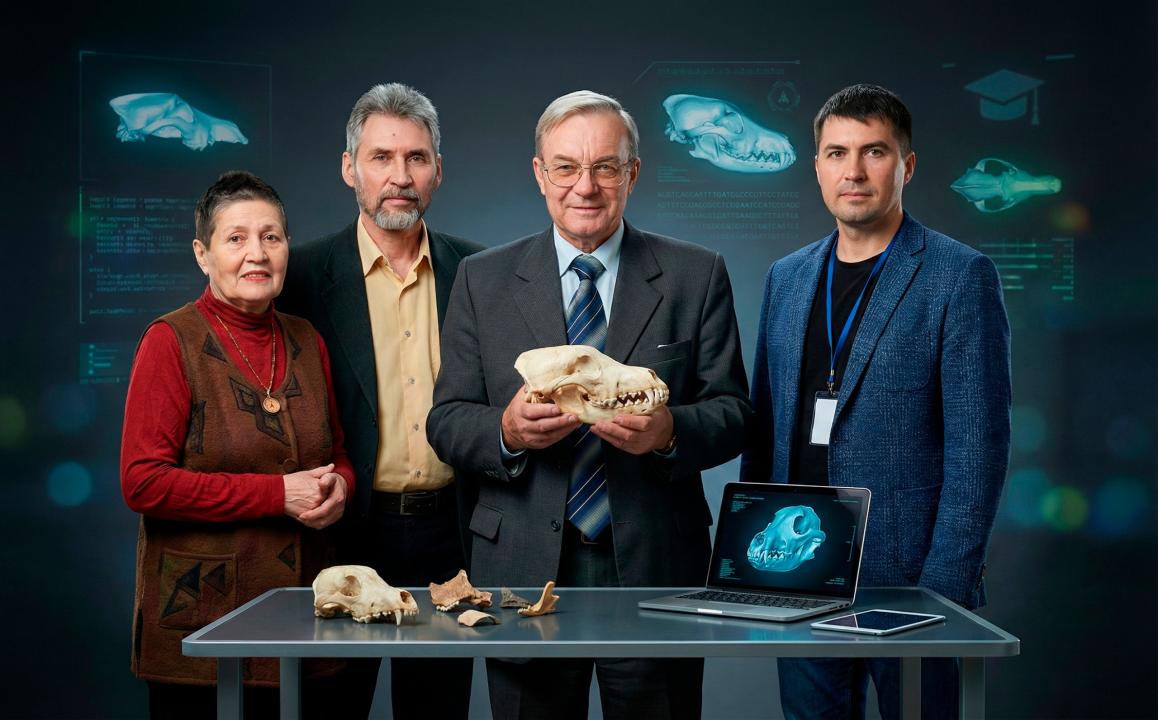
The article “Wide Diversity of Dogs Millennia Before Modern Breeding Practices”, prepared by an international research team representing 40 institutions, has been published in Science, the oldest scientific journal in the United States. The list of authors includes Kazakhstani archaeologists: V. K. Mertz and I. V. Mertz of Toraygyrov University, as well as E. R. Usmanova and V. V. Varfolomeev from the Y. A. Buketov Karaganda National Research University.
The study, conducted under the leadership of the University of Exeter (United Kingdom) and the French National Centre for Scientific Research (France), is currently the most comprehensive of its kind. It encompasses samples dating from the Pleistocene to the present, collected from various regions of the world. Initiated in 2012, the project involved the analysis of 643 modern and archaeological canid skulls, those of dogs and wolves that existed over the past 50,000 years. Through 3D scanning of more than 600 ancient and modern skulls, the researchers established that early Holocene dogs exhibited a degree of morphological diversity comparable to that of today. This indicates that many physical differences characteristic of modern breeds have deep evolutionary roots and emerged soon after domestication.
This pioneering research allowed scientists to identify the period when domestic dogs first began to display the intraspecific diversity typical of them today. Using advanced bone-shape analysis methods, the team traced the emergence of distinct morphological dog types among hundreds of archaeological specimens that lived tens of thousands of years ago. The process of differentiation by size and build began at least 11,000 years ago. As early as the Mesolithic and Neolithic periods, dogs already exhibited a broad range of forms and sizes. This diversity likely reflects their varied functions in early human societies, from hunting and herding to companionship and protection, which led to the relatively rapid appearance of numerous variations that later developed into distinct breeds.
The findings challenge the widespread hypothesis that dog diversity is largely a recent phenomenon resulting from selective breeding in the 19th century. The study demonstrates that significant differences in skull shape and size among domestic dogs existed thousands of years ago, shortly after their separation from wolves. It also highlights the difficulty of identifying the earliest domestic dogs: none of the Late Pleistocene specimens, some of which were previously regarded as "proto-dogs", exhibited skull shapes consistent with domestication. This suggests that the earliest stages of the process remain difficult to reconstruct.